Showing posts with label smedmore family. Show all posts

Friday, 14 September 2012

A Jamaican Childhood -- Growing Up in the Forties

I was probably about six years old when this photo was taken, in the garden at 5 Holborn Road. I grew up during the Second World War, not particularly aware of the war itself, although my family was. I remember, for example, that at 49 Beeston Street where my aunts and uncles lived with my grandmother, there was a picture of the King, George VI, with an excerpt from a speech he gave in his 1939 Christmas broadcast to the British Empire. He quoted from a poem by Minnie Louise Haskins, “The Gate of the Year” and I distinctly remember these words beneath his photograph in the framed picture:

“And I said to the man who stood at the gate of the year, “Give me a light that I may tread safely into the unknown”.
And he replied”: “Go out into the darkness and put your hand into the Hand of God. That shall be to you better than light and safer than a known way”.

I was four years old when the war started and ten when it ended, and yet I don’t have many memories of life being particularly different because of the war. I believe that there were food shortages, especially of imported goods. I have a vague memory of my mother producing a dessert known as “Patriotic Pudding”, probably because of the few ingredients used to make it, but for the life of me I cannot recall what was in it or what it tasted like, only that we were supposed to feel that we were doing our bit for the war effort by eating it!  Another memory that comes to me is from my school days. Around this time, probably when I was about four or five, I was sent to the Surbiton Preparatory School at 7 Surbiton Road, run by the Misses Ivy and Linda Cunningham. Here is an ad for the school from the April 1942 Gleaner:

Miss Linda and Miss Ivy, as we called them, took it in turns to be Headmistress. I’ll speak more about Surbiton Prep in a future post. My reason for bringing it up is that at sometime during the war the school was moved briefly from 7 Surbiton Road to the home of Dr. and Mrs. Ernest Bronstorph on Trafalgar Road, opposite to Holborn Road. They had a large house with spacious grounds, and I distinctly remember that we, the children, took part in training for possible air raids.

I remember that my brother, Micky, who was eight years older than me, was dead keen to “join up”, until he heard of the death in action of one of his friends who had joined the RAF. Our family knew of at least one close friend who was in the War -- Jack Duffus, who served in Egypt, and sent us this photograph.

 
The photo was signed on the back “In the field …Xmas 1944”. The Duffuses were very close to our family. Jack’s parents, Will and Hetty, were Micky’s godparents, and Jack had been a pageboy at my parents’ wedding.

I have a vague memory that Captain Tame who, with his family lived across the road at 6 Holborn Road, may have been in the Home Guard, but I’m not sure. Frederick Tame, his wife, May and their two daughters, Lily and Violet, were very good friends of our family. Frederick Tame had been an officer in the British Army, and we all called him Captain Tame.
This is a photo of Violet with her father, Captain Frederick Tame, in their garden, with Vi holding their Pekingese.

Looking over this post I realize that my memories of wartime are somewhat indistinct. In fact, I was very lucky indeed to be so untouched by the war, not like children in Britain and Europe. My Jamaican childhood was certainly a blessed happy time.

Thursday, 31 May 2012

All the Sevens ... or Way Past My Shelf Date

I’ve been feeling guilty as I haven’t updated my blog for about four months, and wondered what I should write about next. Well, today is my birthday and I’ve reached the august age of seventy-seven … so I thought perhaps it was time to blog about myself for a change. The first thing to think about was what should I call this post? The title “Way Past my Shelf Date” came to mind, based on that wonderful quote from Psalm 90, verse 10: “The days of our lives are threescore years and ten …” which would seem to suggest that to live beyond seventy is to do so on borrowed time … Which is why I prefer “All the Sevens”. In my teenage years and somewhat later I used to go to the Sergeants’ Mess at Up Park Camp with my pal, Sheila Bewley, whose older sister, Dawn, had married a Sergeant, Andy Taylor, who was stationed there. There we played Tombola, a type of British bingo, which, if I remember correctly went up to 99, and was not played under letters like B I N G O , but had its own language. So 77 was “all the sevens”, 99 was “all the nines”, but 66 was “clickety-click”. 21 was “key of the door” … any number ending in zero was “blind”, i.e. 50 was “blind 50”, yet 11 was “legs eleven”, and so on. Perhaps there are some of you out there who remember all this …


I was born on May 31st, 1935 at Nuttall Memorial Hospital, at Cross Roads, Jamaica

The hospital was founded in 1923 built on land purchased by the Diocese of Jamaica and commemorates the work of the Reverend Enos Nuttall, Bishop of Jamaica, after whom it is named.  My parents, Michael Levy and Maud Smedmore, already had one son, Mickey, born 2 April 1927. They were then living at 7 Anderson Road, Woodford Park. My father was a civil service clerk in the Government of Jamaica. There is a photo of my brother, Mickey, probably taken at Anderson Road

 I have no memory of this place to go on, only the photo.

 When I was six months old my parents bought the house at 5 Holborn Road. I found an advertisement in the Gleaner of 5 August 1935 advertising the house as follows:
 I guess they must have bought the house at that time. It’s the only home I remember. Here’s a photo of my parents with me as a baby in front of the house at 5 Holborn Road --

My earliest memory of my birthday is of my fourth … I vaguely remember having this huge tube, like a very large Christmas cracker, which when opened contained all sorts of goodies. I don’t remember the contents, but I do remember dragging the container around the yard of our home at 5 Holborn Road. Somehow this was much more fun for me than whatever had been inside it.

I remember my childhood as being a very happy one. In a way I was almost an only child, as my elder brother, Mickey, was eight years older than I was and would have nothing to do with me. I realize now that, as the only male child in the family he had been quite spoiled until I came along … My mother’s aunt, Aunt Tess, made much of me and poor Mickey’s nose was quite out of joint, as we used to say. This led, of course, to ill feelings on his part, which I now understand, but did not at the time.

Our family was not that large. There were, of course, the aunts and uncles, all Smedmores, and of whom I’ve written before in my blog. I knew nothing about my father’s family on his mother’s side, the Da Costas, something I have always regretted. On the Smedmore side I had two cousins … daughters of my Uncle Lucius who had married Carrie May Burke, aka Maisie. They were both older than me. There was my cousin, Marjorie

And my cousin, Gloria
Marjorie had been born in 1925, so was two years older than my brother, Mickey, thus ten years older than me, and Gloria was born in 1927,a few months after Mickey. Both of them would have considered me as a mere child, so I really had not much interaction with them. I had another first cousin, whom I never met.  This was my cousin, Walter Berner, the only child of my father’s sister, Essie, who had married Cort Berner, and who lived in the United States. He was known as “Bunky”. I never had the opportunity to meet him, but I have made contact since with his daughter, Cheryl..
In my next post I’ll reminisce some more about my childhood memories.


Friday, 9 December 2011

The Smedmores of Port Royal

William Dey Smedmore and his family lived in Port Royal until about 1896, probably on a street very much like this one pictured above. In fact, they lived at two different addresses according to the records I have found. But I’m getting ahead of myself here. Let’s begin with his marriage, as I know very little about him prior to that event.

William married Amanda Brown at the Kingston Parish Church on 6th December 1882. He was a bachelor, aged forty-four, and gave his occupation as writer, H. M. Dockyard. Amanda was a spinster, aged twenty-one, no occupation. Both gave their abode as Port Royal. William gave his father’s name as William Dey Smedmore (dead), and Amanda’s was given as Daniel D. Brown.  They were married by the Rev. G. W. Downer, and the witnesses were B. Mortimer Dias and C. L. Cunha.

Well, there are a couple of problems with this record. No record has so far been found for William’s father, so we cannot be sure that this was indeed his name. Secondly, Amanda’s father’s name was Daniel Elias Brown, so the middle initial “D” is incorrect.  Another oddity is my grandmother’s age. I don’t know if my mother ever saw this marriage record, because, curiously enough, she always claimed that her mother’s birth date was 10 July 1864, and that she was actually only eighteen when she married William. However I have found the record of Amanda’s baptism in the Wesleyan Methodist church, in Jamaican Family Search, and she was definitely born on 9 August 1861, which would agree with her age at marriage. It seems odd to me that my grandmother’s children had a completely different date for her birth, not just a different year but a different month and day!

William’s occupation of “writer in H. M. Dockyard” was also puzzling. I discovered that a writer was  a clerk, a civilian employee in the Royal Navy, at the Dockyard in Port Royal. William’s close friend, George Christopher Baylis, who was a  connection through marriage to his wife’s half-sister, was also a writer at the naval yard.

The first three children were born at
Sime Street
in Port Royal. According to the birth records the two eldest, Sylvia and Victor, were born at no. 2 Sime Street, in 1884 and 1886 respectively, and the third child, Norman, was born in 1887 at no. 1 Sime Street. Shortly thereafter they moved to Fishers Row. I came across a brief note in The Gleaner of 1st May 1888 which mentioned this move.

So it appears that the Smedmore home was to be taken over to be used as barracks for the Army. Might this have had something to do with a story my mother told me about her older brother, Victor? As a young child he had reported seeing a soldier in military dress walking up and down the balcony or piazza of the house they were living in. The tale was that the house had been a barracks and that Victor had seen a ghost. Victor would have been about two years old at that time. It’s possible he saw a real soldier if military personnel came to the house to inspect it prior to taking it over.  At any rate the family moved from there to Fishers Row where the next four children were born – Elma in 1889, Owen in 1891, Maud in 1894 and Rodney in 1896. Then, some time after this they removed to Kingston where the last two children were born – Lucius in 1899 and Julian in 1902.  By 1896 William Dey Smedmore was sixty years old and had retired from his position at the Dock Yard. The family settled down in a large house at
49 Beeston Street
and I have written about that house in a previous post.

In my next post I’ll relate the stories I heard about my grandfather from my mother, as well as a few other items I found in The Gleaner  about him … gold to the enquiring genealogist!

Sunday, 16 October 2011

My Other Grandfather -- William Dey Smedmore

Having just about given up on finding out more about my elusive grandfather, Leopold Levy, I’ve decided to move to my maternal grandfather, William Dey Smedmore … not that’s he’s any easier to research. I have no idea who his father was, and only hearsay evidence as to the identity of his mother. I’ll explain why in a moment, but suffice it to say, I do at least know a great deal more about him than my other grandfather, thanks to the stories I’ve collected from my mother and her siblings over the years. I’ve also been able to find a few records pertaining to him as well as items about him in the Jamaica Gleaner.


My mother’s family lived in Port Royal. My maternal grandmother, Amanda Brown’s family had deep roots there and it’s where my grandfather, William Dey Smedmore, was born.
This is a view of Port Royal about 1890, showing the church and town, looking west towards the entrance to Kingston Harbour.  The town’s heyday was in the seventeenth century when it served as headquarters for the buccaneers who pillaged the Spanish Main, but all that came to an end with the disastrous earthquake of 1692 when more than half of the town was swallowed up by the sea. What remained was a small fishing village with a naval station and dockyard, but even that would pass away. By 1881 the population was 1205, exclusive of shipping. According to Michael Pawson and David Buisseret in their book, Port Royal, Jamaica (1975):

"By [1900] Port Royal's days as a naval base were numbered. The later nineteenth century had seen the rise of the so-called 'blue water school' of British imperial strategists, advocating very powerful fleets operating out of the United Kingdom, supported by a small number of strongly-fortified bases.  The Port Royal yard was too small to rank as one of these, and so in 1905, following the reorganization directed by Admiral Sir John Fisher, her last  commodore, F.W. Fisher, hauled down his flag."

My grandfather, William Smedmore, was employed at the Dockyard as an Admiralty writer, but seems to have retired some time between 1896 and 1899 when the family removed to Kingston.


The image below is of the baptismal record for my grandfather, William Dey Smedmore. As you can see, no parents are named in this record, a clear sign that he was illegitimate. For reasons that are highly frustrating to Jamaican researchers, there is a period of time in the baptismal records where many Anglican priests would not record the names of either parent if the child was born out of wedlock. Some would (very few), and some would at least record the mother’s name. Curiously, the very early registers prior to 1825 recorded all this information, including the fact that the parents were not married, but not so by the 1830s.

William Dey Smedmore … and no one can figure out where the name “Dey” came from … was born 29th October 1836, and baptized on 1st January, 1837. On June 20th of that same year Victoria ascended to the British throne. My grandfather, from all that I’ve learned about him, was a Victorian paterfamilias through and through. He appears to have ruled his family in strict Victorian style and was much loved and feared by his nine children, who called him Papa.  His word was law, and no one defied it. All of the children lived at home after they moved to Kingston from Port Royal. None of those who married did so before his death, and even the eldest son, Victor, who went to England to enlist in the Army in the First World War, waited till 1915 after his father had been dead for over a year.
 
I know very little of my grandfather’s life between his baptism and his marriage to Amanda Brown in 1882. It was my mother who told me, when I was about fifteen, that my grandfather was illegitimate.  I was warned on pain of death not to let on to my two aunts, Sylvia and Elma, that I knew this. According to my mother, William Dey Smedmore was the son of an English sailor and a woman of Port Royal by the name of Ann Wood. When I began my family history research I searched the Port Royal baptismal records and did find a baptism for an Ann Wood, born in Port Royal 2 February, 1811 and baptized 12 October 1813.


Assuming this is my Ann Wood she was the illegitimate daughter of a Port Royal slave owner and vestryman named John Owen Wood. Her mother was one Mary Holms. I cannot, however, prove that she was the mother of William Smedmore. If she were, then she would have been 25 years old when he was born. I have not so far been able to find out anything more about her … whether she married, or when she died.  My mother told me that her father had been brought up by two aunts, but I have no evidence for this and do not even know who they could have been. Indeed, his birth is a mystery!

I found one more mystery surrounding my grandfather. Purely by chance I came across a birth record in Port Royal for one Dorothy Priscilla Theodosia Smedmore, the daughter of an Elizabeth Handfield, born 6 July 1879. No father is named in the record. Could this have been an illegitimate child of William Dey Smedmore? I know of no other Smedmores apart from my mother’s family. This child was born before the marriage of my grandfather. One thing is certain … no member of the family ever mentioned this child and I’m inclined to think that they knew nothing about this, assuming again, that this was my grandfather’s child.


In my next post I’ll continue the story of William Dey Smedmore.

Friday, 27 November 2009

All in the Family -- Lay Delegate to Synod

I recently attended the 135th Synod of the Anglican Diocese of Niagara, as a Lay Delegate representing my church, St. Luke’s, in Burlington.


The word “synod” is defined as “a local or special ecclesiastical council, esp. of a diocese, formally convened to discuss ecclesiastical affairs.” The word is derived from the Latin synodus, from the Greek sunodos, syn + hodos, “way” or “course”. The synod is called together by the bishop of the diocese and the attendees are the clergy from the diocese along with representatives from the laity, elected by the Parish.

The 135th Synod of the Anglican Diocese of Niagara took place November 20th and 21st at the Hamilton Convention Centre. This was my first experience representing my church as a lay delegate to Synod and I found it both educational and uplifting. It set me thinking about my family and the fact that I wasn’t the first of them to attend Synod as a lay delegate. In fact at least two of my uncles had done the same and so I set out to find out what I could about their experiences as lay delegates.

The Smedmores and Kingston Parish Church
My Smedmore family had a strong connection to the Kingston Parish Church. The state church, formally known as the Parish Church of St. Thomas the Apostle, is believed to have been built some time before 1699, the date of the oldest tomb in the church today. It is located south of the Parade, in the heart of Kingston.

The original church was destroyed in the earthquake of 1907. Here is how it looked before the earthquake:


The new church was constructed in 1911, as closely as possible on the foundations of the previous church, as a replica of the former church except for the original tower. Instead a new clock tower was erected as a memorial to the soldiers who died in the First World War.

My Smedmore family, who lived at 49 Beeston Street north of the Parade, all attended Kingston Parish Church and whenever I visited them I would go with there them. I was fascinated by the fact that many early burials had actually taken place inside the church, and one could walk over the tombstones with their inscriptions while going up the nave. I particularly remember seeing the tomb of Admiral John Benbow, near the High Altar.

Benbow had been stationed at Port Royal as commander of the King’s Ships in the West Indies in 1697, and again in 1702. During the War of the Spanish Succession he fought against the French under Admiral Du Casse, was wounded and as a result died two months later of his wounds and was buried in the parish church.

Here is a photo of the interior of Kingston Parish Church, showing the High Altar.

My Smedmore Uncles

But back to Synod and my uncles. I was vaguely aware that my uncle Julian had been a Synod delegate, but what about the others? I don’t know if the eldest of the boys, my uncle Victor, who was killed in the First World War, had taken part in Synod. I never heard that my uncle Owen had been a lay delegate. This might be because he was somewhat retiring in nature. He stammered rather badly and this may have been a drawback. That left my uncles Rodney, Lucius and Julian, and so I did a search in the Jamaica Gleaner online to see what I could find out about them.

Rodney

Rodney definitely was elected as a lay delegate to synod in the parish of Trelawny where he worked as a sugar technologist. He was present at the Synod at St. George’s Hall, Kingston, on February 12, 1947. This Synod was particularly significant as it saw the election of Canon Percival William Gibson as Suffragan Bishop of Kingston, the first Jamaican, and a black Jamaican at that, to be elevated to the bishopric. The article in the Gleaner reports that R. D. Smedmore was one of the delegates appointed to a committee to prepare the voting papers. I know that at the time Rodney was living in Trelawny so he would have been representing his home church, which was most likely St. Michael’s Church in Clarks Town.

Lucius


My uncle Lucius was never, as far as can see, a lay delegate, but he was very much involved in the life of the Parish Church, serving as Secretary and Treasurer. The one member of the family who served the longest as a lay delegate was the youngest, Julian.

Julian

I found several entries in the Gleaner which referred to Julian’s involvement as a lay delegate on behalf of the Parish Church. He was very active in the church and made sure everyone knew it!

So, I came to the conclusion that this was indeed all in the family. Mind you, I’ve come to this important duty somewhat late in life, but I rather think that if my Smedmore family knew of it they would probably be proud and perhaps a bit surprised as in their time there were probably no women in Jamaica elected as lay delegates to synod. In fact, it was not until 1994 that women were ordained as deacons, and only in 1997 were they ordained to the priesthood.

Monday, 17 September 2007

About My Uncles -- part 3

And now to the two youngest Smedmore boys, my uncles Lucius and Julian. My Uncle Lucius was born at 49 Beeston Street on 18 November 1899, the eighth child of William Dey Smedmore and his wife, Amanda. I have only one photograph of my Uncle Lucius, not a very good one ... probably a passport photo. Here it is:


He had apparently sent the photo to his cousin, John Cassis in Toronto, as on the back of the picture he had written:

"This is a recent snap but I don't think the photographer has done me justice. You know, John, I was never half as ugly. Best love to Fanny, yourself and the family, from Maysie and self, Lucius".

Maysie was his wife ... more of that in a moment. My grandfather would have been sixty-three when Lucius was born, and sixty-seven when Julian, the youngest, was born four years later in 1902. It boggles the mind to think how difficult it must have been for these younger brothers to have a father who was old enough to be their grandfather. And when he died in 1914, Lucius would have been fifteen and Julian just eleven. I think they were probably brought up more by their older sisters and mother as my grandfather was not a well man in his latter years, suffering with serious migraine headaches which may well have been the pre-cursor of the cerebral haemorrhage which killed him. I remember my Uncle Rodney relating how they had to keep quiet most of the time because of his father's headaches. Rodney, apparently, loved to build things and was hammering together a chicken coop when told to stop because his father couldn't stand the noise. He was somewhat resentful about that, I remember.

But back to Lucius. Like other members of his family he was a Freemason, a member of St. John's Lodge, and he also worked for Henderson & Company, eventually becoming secretary of two of their sugar estates Orange Valley and Georges Valley in Trelawny. (When I visited Jamaica in 2003 I spent an afternoon at Orange Valley and saw the ruins of the old sugar factory and slave hospital. I also saw the paw-paw grove at Georges Valley. Paw-paw, aka papaya is now a popular export fruit.) Here is a picture of a section of the grove:


Lucius married quite young by Smedmore standards, when he was twenty-four, to Carrie May Burke, the daughter of Aubrey Mapletoft Burke and his wife, Amy Ann Depass. Maysie was three years younger than Lucius. From what I've been told there was some opposition to the marriage from Lucius's mother and two older sisters but he was determined to get married. The marriage was written up in the Jamaica Gleaner and was apparently considered quite the event of the season. Rodney was best man and Lucius's brothers, Owen and Julian, were ushers. The ceremony was performed by the then Bishop of Jamaica ... not surprising as Lucius, like all the Smedmores, was a pillar of the Kingston Parish Church and in fact was a member of the Parish Church Committee.
Lucius and Maysie had two daughters, Marjorie and Gloria, both of whom were quite a bit older than me so we were not very close as cousins. Unfortunately, the marriage ended in divorce in 1956, though they remained friendly and Lucius went to live with Marjorie and her husband, Eric Crawford on Trafalgar Road. It was there, in May of 1963, that Lucius was brutally murdered by a thief. He was alone at the time, as Eric and Marjorie had gone on a holiday to Mexico. The murderer was eventually caught, confessed, was tried and found guilty, and hanged. This event was a tragic one in the family. At the time my parents were visiting me and my family in Winnipeg where we were living, and it was a tremendous shock to them. Worse was to come later that year when my brother, Micky, died of a cerebral haemorrhage in October.

And now to my Uncle Julian, the youngest of the family, the apple of his eldest sister's eye, as I was told. He was different from the others, a very volatile person, someone who had strong likes and dislikes, and in fact, the only uncle that I ever had a falling-out with. He was quite the sportsman. He played cricket and was a member of several clubs. Unlike the others to the best of my knowledge, he did not become a Freemason, but he was a staunch member of the Kingston Parish Church and was a lay delegate to Synod for many years. He was always perfectly turned out in his dress and affected a very British accent, though he would, at times, lapse into Jamaican patois. He was known, affectionately, by family and friends as "The Count".
He married, somewhat late in life at age fifty, Enid Neilson, the daughter of the Reverend Christopher Charles Neilson, a Methodist minister. They were married in Lyndhurst Methodist Church in 1953 and the reception was held by my parents at 5 Holborn Road. To the best of my knowledge Julian continued to attend Kingston Parish Church while Enid remained a Methodist.
I mentioned having a falling-out with Julian. It was some months before my wedding in 1957. I had had an emergency appendectomy and was at home on sick leave, feeling rather sorry for myself, as my mother was in Toronto at the time visiting my brother and his wife and their new baby. I was invited by Julian's sister-in-law, Ruby, to visit her family in Morant Bay. Unfortunately, Julian had quarrelled with Ruby's husband, Edward, and he informed me that "no niece of mine will visit these people, since I have quarrelled with them". I wasn't about to take this interference in my life and we had a fierce quarrel and did not speak for almost six months. I seriously considered uninviting him to my wedding but cooler heads prevailed ... my mother told my I could not do that! ... and we made it up. For all his peculiarities he was a very affectionate uncle. He and Enid had a volatile relationship, but when she was struck with a massive stroke which left her unable to speak, he was devastated, even more so when she died shortly afterwards.
This is a photo of the two of them taken in happier times:

Monday, 3 September 2007

About My Uncles -- part 2

I have just returned from a wonderful twelve days in Newfoundland. I felt a real sense of belonging while I was in that rugged island. Perhaps it was the fact that I too came from an island and was going to another island, a unique place in this vast country. But, more than that, Jamaica and Newfoundland have much in common ... they gave us the cod which we make into our salt fish, and we gave them the rum, which they made into their Screech. The cod fishery in Newfoundland is no more, but that connection still remains.

But back to my uncles. The younger three, Rodney, Lucius and Julian, unlike their three older brothers, all married, two of them somewhat later in life. My Uncle Rodney was born in 1896, a little less than two years after my mother, and the two of them were very close. Rodney was both my godfather and my favourite uncle.

He was a sugar technologist by profession and this took him to various sugar estates on the island. Here is his entry from the 1940-46 Who's Who Jamaica:

Before Rodney married Marjorie Nash he was engaged to be married to Olive May, a teacher at St. Hilda's Diocesan High School in Brown's Town. I remember meeting her once when she came with Rodney to our home at 5 Holborn Road , and I distinctly remember that she told my mother that she should send me to St. Hilda's when I was old enough to go to high school (I was then at the Cunningham's Preparatory School on Surbiton Road). The realization that this would mean leaving my home and my parents to go as a boarder far away in Brown's Town terrified me. Some time after that Rodney informed the family that his engagement had been broken off. My mother was quite upset about this for a while, whereas I felt an overwhelming sense of relief that I wouldn't be heading off to parts unknown to boarding school.

Looking back now, I see was that I was somewhat unfair to Olive May.Thanks to Donald Lindo I now know more about her and also have a couple pictures of her. She was born in Portsmouth, England, in 1917 and received her B.Sc in Mathematics from London University, as well as a Diploma in Education from the University of Hull. She came to Jamaica in the late 1930s and began her teaching career there at St. Hilda's.


I don't know how she met Rodney ... he was probably working in the area at the time. It is unfortunate that their engagement did not last, and I never knew the reason why, but I rather think that the disparity in their ages and temperament may have had something to do with it. From what I've been told Olive was a lively and adventurous woman with a brilliant mathematical mind, but she was also twenty-one years younger than Rodney. I hope that they parted amicably. At any rate, Rodney married Marjorie Nash in September of 1941 in Sav-la Mar. I was a train-bearer at this event. Marjorie's sister, Hazel, was bridesmaid and my Uncle Owen was bestman.


Here I am standing in front in the middle. I must say we all looked pretty solemn, except for the bride and groom who are looking lovingly at each other.

Olive May married Leslie Kensett, a British Army officer, in 1945. They returned to England, but the marriage was not a success and Olive came back to Jamaica where she resided until her death in 2000. She taught at St. Hugh's High School in Kingston, where she was much loved and was Head of the Math Department, until she left to go to Queen's High School for Girls in 1958 as Head of the Math Department there. She was universally loved by all her pupils and renowned as an excellent teacher. Looking back now I feel that she had my best interests at heart when she suggested I be sent to St. Hilda's, but I was only six at the time and didn't want to leave my family.

Rodney and Marjore were happily married for twenty-eight years until her premature death at age 59 in 1969. She had been a diabetic from her early twenties, as a result of which they had no children. I loved her dearly and still miss her. I plan to write more about both of them in future posts.

In my next post I'll write about my remaining Smedmore uncles, Lucius and Julian.

Thursday, 16 August 2007

About My Uncles

In my last post I mentioned a picture which hung in the dining room of 5 Holborn Road, of the Princes in the Tower. Our picture was a black and white print, not colour like the one above, and below the picture were these lines from Richard III, as spoken by Queen Elizabeth:

"Pity, you ancient stones, those tender babes
Whom envy hath immured within your walls!"

'Envy', in this case, personifies Richard III, the quintessential wicked uncle, at least as Shakespeare portrayed him. Personally, I belong to the revisionist school of thought which believes that Richard received a bum rap. Read Josephine Tey's wonderful novel, The Daughter of Time, and check out the Richard III Society of Canada, who each year on August 22nd, place an In Memoriam notice for Richard in the Globe and Mail. In case you're wondering why I'm mentioning this, it's because my daughter asked when I was going to write about "the wicked uncles". Well, I had no wicked uncles. They were all regular uncles ... each with his own foibles and peculiarities, but nothing out of the ordinary, except, perhaps, that the eldest three never married.

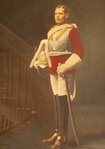
My very first post was about my Uncle Victor, the eldest of the Smedmore boys, who went to England in 1915 and joined the Life Guards of the Household Cavalry, was sent to France with the combined battalion of the Reds and the Blues which made up the Household Battalion of the British Expeditionary Force, and was killed in action in 1918. I never knew him of course, only what my mother would tell me about him, and what little information I found about him in the online Daily Gleaner, which reported on his joining up and on memorial services held after his death. The only picture I have of him is a large framed painting , which may have been a photograph which was colorized, showing him in his Lifeguard uniform.


I remember another picture of him, at 49 Beeston Street, one of a group of three soldiers in their khaki uniforms, but I have no idea where that picture ended up.
Victor was born in February 1886, and the next son, Norman, was born the end of November 1887. He is another uncle that I never knew, and in a way he's the real mystery man of the family. He doesn't seem to have been as popular with his sisters as was his older brother ... but then, getting killed in the war does give one a certain cachet. Norman, known by the family as Normy, also left Jamaica, but not to fight. Like many other Jamaicans he headed off to New York in June 1918, on board the ss Zacapa. On the ship's manifest he gave his next of kin as his mother at 49 Beeston Street, and stated he was going to stay in New York with a friend, Joseph Levy. Joseph Levy was the youngest brother of my father and had himself left Jamaica for New York in August 1917. Norman claimed on the manifest that he was going to the U.S. for six months but he certainly never returned to Jamaica. He lived there until his death in July 1953. I have no photographs of him and all I know of him is what I've been told by my mother, and what I've been able to find out through research. He settled first in Brooklyn where he worked as a traffic checker for the Public Service Railroad Company, and in September 1918 he filled out a registration card for the draft. After that he appears to have worked for the rest of his life in New York for Swift & Company, meat packers. Thanks to David Priever, a researcher in New York, I was able to get a copy of the administration of his estate from the Surrogate Court of New York ... like many of the Smedmores, he left no will ... and what ever else I know about him comes from this brief obituary in the Gleaner of August 8, 1953. That Norman was a Freemason doesn't surprise me as my grandfather and my Uncles Rodney and Owen also belonged to the Scottish Rite. I had not known that, like Victor, he attended Wolmer's Boy School, nor that he had worked for the lumber companies in question. I do know, from what my mother told me, that he would send money home for his mother and sisters, and I know, from a brief notice in The Gleaner that Elma went to New York on vacation in June 1951,so I imagine she must have visited Norman. One thing I do remember is how surprised the family was at how small his estate was -- according to the lawyer, Albert Stark, a mere $4,400. Considering that Norman never married, lived in lodgings and had worked steadily since arriving in New York, this small amount to be divided between his siblings, after all expenses had been paid, came as quite a shock.

I come now to the Smedmore uncles that I did know. The next one in the family was my Uncle Owen, born in November 1891 in Port Royal. To my mind he was the best looking one of the family and it always puzzled me that he never married.


I think one reason may have been that he had a speech impediment, a stammer, as did Rodney and Lucius, though I remember that Owen's seemed to be the worst of the bunch. There are probably all sorts of scientific reasons for speech impediments, but I feel pretty sure, from what my mother told me, that this was exacerbated by my grandfather's treatment of his sons. He had no patience when they stuttered and would tell them to speak up without stammering. I think Owen was probably shy. He worked all his life at D. Henderson and Company at the corner of King and Harbour Streets.

I remember him as gentle and generous. I could always touch him up for money at Christmas time when all the family gathered at 5 Holborn Road -- two shillings and sixpence or even five shillings, and then, of course, I would go to the other uncles and tell them how much I got from Owen, and they, not wanting to be outdone, would shell out as well.

I guess Owen felt he had an obligation to take care of his mother and sisters, once Victor had left for the war and Norman had emigrated to the States, consequently he lived at home with them, first at Beeston Street, and then later he moved with my aunts to 11 Dunrobin Avenue when the Beeston Street house was sold. I would say he had a very powerful sense of duty to his unmarried sisters and I know that he was a loving brother and brother-in-law. Sadly, he was on holiday when he died. The family had gone to White River for a vacation when Owen suffered a heart attack or a stroke while swimming.

In my next post I'll write about my other uncles, Rodney, Lucius and Julian. It may be a while as I'll be off line while on vacation for two weeks.

Thursday, 14 June 2007

About My Aunts

Aunts. We have aunts by blood (the sisters of our father or mother) and aunts by family (those who marry our uncles). In Jamaica we had a third kind of aunt and uncle ... any older couple who were good friends of the family, perhaps even distantly related. It was too formal to call them Mr. or Mrs. and we would never have dreamed of calling them their first names, and so we called them "Aunt" and "Uncle"
This post is about my real aunts, sisters of my father and mother. I had three: my aunts Sylvia and Elma Smedmore, my mother's older sisters, and my aunt Essie Levy, my father's sister, whom I never knew and of whom I'll write another time. My aunts Sylvia and Elma never married and lived at 49 Beeston Street until the house was sold in the fifties, at which time they moved with my Uncle Rodney and his wife, Marjorie, to 11 Dunrobin Avenue. As far as I was concerned, Sylvia and Elma were pretty old when I knew them. This picture of Elma, Sylvia and Rodney, must have been taken in the fifties or sixties.
I imagine that looking into the bright sun is the reason they look rather grim!
It's hard, sometimes, to imagine one's elderly relatives as having been young themselves, so we're lucky when we find photographs of them when they were young. Here is a photo of a much younger Elma.
Elma was the fourth child in the family, born November 8, 1889, at 11 Fishers Row, Port Royal. While in Port Royal the Smedmores also lived at No. 2 Fishers Row, and No. 2 Sime Street. Now, I have been fortunate enough to obtain a postcard in Gardner's Series, of A Street in Port Royal, which I imagine is probably very much like the streets that the Smedmores lived on.

The houses on the left show the same Georgian style of architecture as the house at 49 Beeston Street.

Elma was always somewhat serious and somewhat strict as I remember her. My mother claimed that she did have at least one suitor who wanted to marry her but she refused him. I have no idea who that might have been.

Sylvia was the eldest child, born January 20, 1884, at No. 2 Sime Street in Port Royal. I never found any early photographs of her among the family pictures, but some time ago I made contact with the granddaughter of my father's sister, Essie. Cheryl lives in Oklahoma and she sent me a package of photos, many of which, unfortunately, neither of us could identify. There is one which might be of Sylvia as a young woman. The picture was definitely taken in Kingston, Jamaica. On the front left corner of the picture is the word "Cleary's", and on the right corner "Fine Art Studio, Kingston, Ja." On the back is the photographer's name, "J. W. Cleary, Kingston, Jamaica". I sent a scan of the photo with the stamps to Donald Lindo in Jamaica and he forwarded it to David Boxer, Director Emeritus and Chief Curator of the National Gallery of Jamaica. He very kindly wrote me to say that he would date the photo between 1900 and 1910, before the firm became Cleary and Elliott, one of the best known photography studios in Jamaica.

So, is it my Aunt Sylvia? I don't know ... it could be, and it's a nice picture. I like to think that it is her photo, as my actual memories of her are of an elderly, tall, thin, somewhat tottery old lady who never seemed to be in very good health. Perhaps that's the reason she looks somewhat unhappy in later pictures. She died July 19, 1970, at Dunrobin Avenue. She was eighty-six years old. Her sister, Elma, died eight years later,at the age of eighty-nine.


Wednesday, 16 May 2007

All About My Mother ...

I should have had this done for Mother's Day but other stuff intervened ...

My mother always told me that she and my Dad were engaged for seven years. Why, I asked? Well, he had to help support his mother who was a widow. He was the eldest son ... the two younger boys, Leo and Joe, had gone to the United States, and the only girl, Essie had also left for New York. The funny thing about this story was that my grandmother Levy was afraid that Leo and Joe would be forced to join up during the First World War. (My father, apparently, was not considered fit enough to join up .. I think he had flat feet). Since the Americans weren't in the war then it seemed a good idea to send Leo and Joe to the States. Well, I never did find Leo's immigragion record, though I'm still looking. He probably went to the States before Joe, who sailed to New York aboard the ss Catherine Cuneo on August 28, 1917. Considering that the U.S. had entered the war in April 1917 this particular reason doesn't seem to make a lot of sense where Joe was concerned! At any rate, my Dad remained in Jamaica, the sole support of his mother, as my grandfather, Leopold Levy, had died in February 1917 in Santiago, Cuba.

But this is supposed to be about my mother. She was the youngest girl of the three Smedmore girls, the only one to get married and the only who ever actually worked outside the home.


This picture was taken before she was married to my father. I think, looking back now at what I know about her, she would have been considered a feminist for her time. Yes, they did have to wait to get married because of my father's responsibilities, but I gather there was also some opposition to my father from my grandmother Smedmore and my two aunts, Sylvia and Elma. Which brings up another interesting fact about the Smedmore family. Not too many of them got married, and most of those who did married later in life. (Except for my uncle, Lucius, who defied the family and got married at the tender age of twenty-five.) When I asked my mother why three of my uncles and my two aunts never married her response was that the men had never found a woman as good as their mother and the women had never found a man to equal Papa.

This opposition, however, did not deter my mother and my parents were finally married on April 27, 1926, at Kingston Parish Church, and as the reception appears to have been held at 49 Beeston Street one must assume that the family came round in the end. In fact, Julian, my mother's youngest brother, was best man.

Things must have been difficult for my parents at the beginning of their marriage. They could not at first afford their own home and lived at 49 Beeston Street for some time. My brother, Michael Owen Dey Levy, known to all as Micky, was probably born there on April 2, 1927. I don't know how long they lived there. One of my Da Costa cousins remembers visiting my Grandma Levy at her house at 22 Beeston Street and recalls that my Dad came over to visit with his friend, Joe Kelly, and a little boy, which was most likely my brother. Here is a photo taken at 49 Beeston Street of Micky with our cousin, Marjorie, eldest daughter of Lucius, and our aunt Elma in the background.

Micky was probably about four or five when my parents moved to a house on Anderson Road which I think they probably rented. I wish now I'd asked what the exact address was. In fact, there are a lot of questions I wish that I had asked my mother ... this is the main regret of most genealogists who come to family history later in life and realize that they've missed the opportunity to talk to the family elders and get all the facts and stories...now lost in the mists of time.


Saturday, 28 April 2007

Visiting Kingston -- My Two Grannies

My four grandchildren are very lucky in that they have known all four of their grandparents. I was not so fortunate. Both my grandfathers had died before my parents were married; as for my grandmothers, well, I knew them for only a short time in my childhood. Both of them were born in 1861, and both died in 1943, at which time I was just eight years old. I do remember them, however. They lived across the street from each other: my Grandmother Smedmore lived at 49 Beeston Street and my Grandma Levy lived at 22 Beeston Street.

I have a better memory of my Grandmother Smedmore because I probably saw her more often. Sadly, I have no pictures of her or of my grandfather, William Dey Smedmore. I do have a photograph of my grandmother's youngest sister, Theresa Eugenie Brown, and I rather think there must have been a resemblance between them. This is my Aunt Tess.


Aunt Tess was the Postmistress for many years in Montego Bay, but that's another story.

I would go to Kingston with my parents to visit the grannies. This was always a treat for me, living as we did in the suburbs of St. Andrew. Kingston was different .... busy, lots of people on the streets, all sorts of stores, higglers and vendors selling things on the sidewalks, and we got to ride the tramcar!


I remember that I used to tell my Grandmother Smedmore Anancy stories, which she enjoyed very much. Anancy, or Anansi, is a figure of folklore, a spider, a trickster hero, based on folktales brought from West Africa. Another Jamaican blogger, Floyd Brooks, has posted an excellent article by Marcia Davidson on Anancy stories on his blog, Jamaica Land We Love.

We didn't visit my Grandma Levy as much. I have one memory of her ... the room she was in was quite dark, and I do not really remember much about the house. I remember she was dressed in white. The room was probably dark because Grandma Levy was blind. She had had cataract surgery, which in the 1930s and '40s was nothing like what we know today ... no lasers! Patients had to lie completely still on their backs, with the head placed between two sandbags to keep it perfectly still as any movement too early after the surgery could cause blindness. My Grandma Levy was subject to nightmares and apparently had one which caused her to start up suddenly, and as a result she lost her sight. I remember she talked about her late husband, Leopold, but I do not remember what she said and at that age I wasn't particularly interested. It would be a long time before my interest in family history would lead me to find out what I could about him and about my Grandma Levy's past.


Friday, 20 April 2007

The House at 49 Beeston Street


The red block at the corner of Beeston Street and Love Lane shows approximately where the house at 49 Beeston Street, the Smedmore family home, was located. My memories of it are as a child and a young teenager. Unfortunately there are no photographs of the exterior of the house. I think the exterior architecture would have been considered in the Georgian style, something like this photograph taken in 2003 in Falmouth, Trelawny, Jamaica.


Colin G. Clarke, in his book, Kingston, Jamaica: urban development and social change, 1692-1962 (Berkeley: University of California Press, 1975), quotes Michael Scott who wrote of the architecture in Kingston in the 19th century as follows:


The appearance of the town itself was novel and pleasing; the houses chiefly of two stories, looked as if they had been built of cards, most of them being surrounded by piazzas from ten to fourteen feet wide ... On the ground-floor these piazzas are open ... on the floor above, the balconies are shut in with moveable blinds called "jalousies", with large-bladed Venetian blinds fixes in frames....


I don't know when the house at 49 Beeston Street was built. I do know that it was occupied by the family of Louis Cunha in 1878 (of whom more in future).


The house sat on the north side of Beeston Street, and well up from the street itself. There was a set of steps, perhaps about six or so, which led up to the house. There was in front a large piazza open to the air, which was never used by the family. The steps themselves led to a door in a wall ... for the entire property was surrounded by a high cement wall. You entered this door and were immediately completely away from the street outside. A short path led to the open back verandah on the left, and on the right was the courtyard which included a large Jamaican cherry tree, and in the walled garden all sorts of tropical plants mainly crotons, coleus and ferns.


The house itself consisted of two bedrooms on the ground floor, as well as a full bathroom, all off of the back verandah. Across from the back verandah, to the north of the house, was a separate building, connected to the house by a covered walkway. This building contained the dining area, pantry and to the west a laundry room. To the east of the house at the end of the property were other outbuildings, including the kitchen with huge wood burning stove, and servants's quarters.


The second storey, which one reached by a staircase, contained in the centre a large with-drawing room, and off of that four bedrooms with a bathroom. At the top of the stairs was another bathroom, which may have been added later, and another bedroom overlooking the courtyard. When I visited the house as a child, the large bedroom on the ground floor belonged to my eldest aunt Sylvia (and had originally been my grandparents' room), and the other bedroom was that of my youngest uncle, Julian. Two of the bedrooms upstairs were occupied by my aunt Elma and my uncle Owen. Whenever I stayed over I had one of the smaller bedrooms overlooking Love Lane.


My parents, Michael Leopold Levy and Maud Dey Smedmore, were married in 1926 and their wedding pictures were taken in the courtyard of 49 Beeston Street. This picture of them together is taken to the east of the house and one can see the kitchen outbuilding in the background.


Arras Memorial

Arras Memorial

Trooper Victor Dey Smedmore

Trooper Victor Dey Smedmore
My uncle Victor