Showing posts with label 1907 earthquake. Show all posts

Saturday, 3 May 2008

Father Joseph Dupont's Statue

It's been a while since my last post. A little over two weeks ago I had surgery -- total knee replacement, and so it's slowed me down a bit.

I want to return briefly to the 1907 Earthquake and one of the stories of the quake, the damage to the statue of Father Joseph Dupont. You may remember that this is what it looked like after the earthquake:
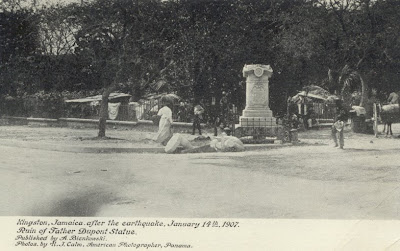

The statue was quite badly damaged as you can see. You may also remember that I showed another photo, taken about 1940, showing the statue after it had been repaired.


I didn't give much thought to what had happened in between, such as when was the repair done and how it was accomplished, until, while browsing through Father Francis X. Delaney's History of the Catholic Church in Jamaica, B.W.I., 1494 to 1929 (New York: Jesuit Mission Press, 1930) I came across the story behind the repair of the statue. On page 256, Father Delaney writes:

"Since the day of the great earthquake, January 14, 1907, the pedestal that supported the statue of Father Dupont, had stood empty in the Kingston Parade. It had become a spectacle of the great disaster, as well as of civic neglect and ingratitude. In the course of the year 1924, Mr. Alexander Falla started a movement to have the monument restored. A public-spirited citizen, Mr. S. J. Streadwick, opened the fund, and Mr. James Dunn contributed the substantial sum of fifty pounds. The editors of Catholic Opinion and of the daily Gleaner took up the cause and the result was that about two hundred and twenty pounds were collected from people of every class and creed. The statue was publicly unveiled by the Governor of Jamaica, Sir Edward Stubbs, and presented to the city of Kingston, represented by the Mayor, Honorable A. E. DaCosta, on Sunday, September 11, 1927, the year which marks the eightieth anniversary of Father Dupont's coming to Jamaica and the very day which marks the fortieth anniversary of Father Dupont's leaving his adopted Jamaica for his home in Heaven".

This was indeed an ecumnical effort to restore Father Dupont's statue. S. J. Streadwick, for example, was a staunch Anglican, yet, as Father Delaney writes, people of all classes and creeds moved together to subscribe to the statue's repair.

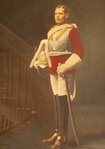
I'm interested in Father Dupont because he baptized some of the children of my great grandparents, Jacob Rodrigues Da Costa and his wife, Selina Jane Roberts. Here, from Father Delaney's book, is a picture of Father Dupont.


According to a brief story in the Gleaner of January 28, 2007, Father Dupont was born in Savoy, France in 1809, and came to Jamaica as a priest in 1847 where he remained for forty years ministering to the poor and establishing missions all over the island. The original statue to his memory was erected in 1892, by public subscription and the Gleaner notes that Father Dupont was the only clergyman to have a statue erected in his honour in Jamaica, so he must have been universally loved and respected.

Sunday, 10 February 2008

Falling Walls -- the 1907 Earthquake -- part 2

It is not known exactly how many people perished in the 1907 earthquake and subsequent fire that ravaged the city of Kingston on January 14th, 1907. Estimates range from 600 to 1000. Lists of the dead and injured can be found on line: on the Jamaican Family Search, as reported in the Gleaner of January 18, 1907 and a further list of victims in the paper of January 21, 1907. The Genealogy of Jamaica webpage also lists victims of the earthquake, extracted from the Gleaner of March 2, 1907. I have spent some time going through the death registrations for 1907 for Kingston. There are names that appear on the death lists for whom there is no registration, and conversely, death registrations for some whose names are not on the lists. For the majority of those killed on January 14th the cause of death given is "Killed by falling walls". Not everyone died instantly; many died later in hospitals as a result of their injuries or of tetanus from amputation of a limb or limbs. The Mayor of Kingston, Charles Walter Tait, was one who died later -- on 10 February 1907, of "concussion of the spine".


The downtown business area of Kingston was most affected by the quake. Some places of business lost a number of workers. Nine staff members at the Myrtle Bank Hotel were killed. Here are two postcards of the Myrtle Bank Hotel, before and after the earthquake:


I found death registrations for six members of the staff of Emanuel Lyons and Sons Ltd. at the corner of King and Harbour Streets. This postcard of what was left of the building shows how devastating the damage must have been.


As I read through the records I found a variety of comments under cause of death. One woman, Lucinda Allen of 4 James Steet, married, age 40, died "apparently from fright -- no injury". Thomas Bernard Philpotts, cigar maker, age 57, died of "heart disease and fright due to the earthquake". Another woman, Henrietta Pinnock, "died after premature delivery brought on by shock received from the earthquake". One of the saddest I found was the record for a little girl, Emily Letitia Jopp, age 6. On her record this note was added: "This little girl was found dead with a slate beside her on which she had just written 'God is Love'".

It would be too easy to say that people died because they were in the wrong place at the wrong time -- that sentiment could refer to all those who lost their lives, but some deaths stand out, such as that of Marcus Moses Delgado. Thanks to Stephen Delgado Porter I know something of Marcus' history. He was the son of Edwin Delgado and had married Miriam Brandon, daugher of Nathaniel Brandon. They had six children. In December 1904 Marcus emigrated to Cartagena, Colombia, to improve his fortune, leaving his wife and children in Kingston. He returned to his family at Christmas 1906 and on January 14th, 1907, went downtown to buy his daughter, Sybil, a birthday present -- that day was her eleventh birthday. Marcus was killed by falling walls, at the corner of Harbour and Duke Streets. He was 48 years old.


Another casualty,somewhat closer to me. was that of Bertie Bold Vendryes, the wife of Philip Camille Vendryes. Bertie was the daughter of George Christopher Baylis and his wife, Elizabeth McDonald. Elizabeth was the step-daughter of my great grandfather, Daniel Elias Brown who had married her mother, the widow of Donald McDonald. Not only were the Brown and the Baylis families close but George Baylis worked at the Dock Yard in Port Royal along with my grandfather, William Dey Smedmore. Bertie, who was pregnant at the time, died on January 23rd at Winchester Hospital,as a result of premature delivery brought on by the earthquake,as well as puerperal fever and heart failure. The child, a boy, Joseph, did not survive. Also killed on January 14th was Bertie's and Philip's daughter, Vida, who was nine years old. So Philip lost his wife, his daughter and his newly born son.

Many well-known buildings in Kingston and elsewhere in the island were damaged or totally destroyed. The Kingston Parish Church lost its steeple and its clock.


The tower and clock were restored but without the steeple.
Some odd things happened as a result of the earthquake; for example, the statue of Queen Victoria at the Parade was turned completely around,


and the statue of Father Joseph Dupont, one of the longest-serving Jesuit priests in Jamaica, was knocked completely off its pedestal.

It is no wonder that there are so many postcards of the damage wrought by this earthquake, the worst that Jamaica had experienced since the 1692 quake which destroyed the town of Port Royal. In a matter of a minute or two so many buildings in the city were reduced to rubble and so many people died. Yet the people of Kingston would come back from this devastation. As the Gleaner of January 18, 1907, put it:

"Just when we were talking of returning prosperity the hand of adversity has again touched us, and once more we are called upon to fight our way forward. We will do so. We will not allow ourselves to be terrified. We will build Kingston again and, with God's help, will build it better."

Thursday, 17 January 2008

When the Earth Moves -- the 1907 Earthquake

I'm leaving the Levy Family story for a while to write about the 1907 earthquake which happened 101 years ago on January 14th. This event fascinates me, not just because my family experienced it, but because it became more personal when I discovered that some family members had perished in the earthquake. I am fortunate to have several postcards showing the devastation after the event. This postcard shows a burnt out streetcar on King Street.

Growing up in Jamaica meant living with the dangers of two natural disasters -- hurricanes and earthquakes. I was less afraid of hurricanes because at least you could see them coming, whereas earthquakes give no warning of their arrival. I lived through Hurricane Charlie in August 1951 and I remember all the preparations we made at 5 Holborn Road to withstand that event. It was very scary while it lasted but we survived with some water damage and the loss of trees which, fortunately, did not damage the house in their fall. Charlie was the worst disaster to hit Jamaica since the 1907 earthquake and did a great deal of damage. You can read more about in on the website of the Office of Disaster Preparedness and Emergency Management. Here is a photo of the United Fruit Company in the aftermath of Hurricane Charlie.

In March 1957 Jamaica experienced an earthquake of some magnitude, the epicentre of which was located in the western part of the island where most of the damage was done. It was about 7:30 in the evening and I was outside playing badminton next door with my friend, Sheila Bewley, when the earthquake struck. We could literally see the earth moving in waves while the electrical wires sparked and flashed. It was terrifying for the brief time it lasted. I had felt other earthquakes but none as strong as that. Frightening as this earthquake was to me it could never equal what the inhabitants of Kingston must have felt that afternoon on January 14, 1907. I will not try to describe the earthquake -- there are many excellent accounts by eyewitnesses and others. I recommend the article from the Jamaica Gleaner Pieces of the Past. Another excellent source is the book, The Cruise of the Port Kingston, by W. R. Hall Caine (London: Collier, 1908) which includes an eyewitness account of the damage which amounted to £2,000,000 as a result of the earthquake and subsequent fires. Over 800 people lost their lives, mainly from falling walls during the earthquake.

Prior to the 1907 earthquake Jamaica had experienced one other devastating quake -- the Great Earthquake of 1692 which destroyed more than half of Port Royal. This event had such an effect on the Jamaican psyche that the event was commemorated until well into the 19th century every year on that day, June 7th, "as a perpetual anniversary fast", as per the The Great Earthquake: Acts of William and Mary,A.D. 1693, . By this statute all places of commerce were closed and the day was to be spent in the churches "with prayers, preaching and singing of psalms". The following police notice to this effect appeared as late as June of 1866:


Over the years merchants and shop-keepers complained about having to close their stores on that day and in 1866 the Gleaner reported that several merchants had been fined 24 shillings and costs for not closing their businesses on the day. By 1867 the Government passed Law 4 by which the Act was no longer to be read as obligatory but as permissive. However, well into the 1890s banks and government offices were closed on June 7th and services were held in the churches.


The earthquake of January 14, 1907, struck without warning. Hall Caine compares the noise of the quake as follows:
"The heightening roar is of eternal memory -- it was as though some vast herd of tigers, with warm blood already on their tongues, had been suddenly robbed of their prey".

His first view of the city of Kingston after the quake is devastating:


"At 3:32 Kingston was happy and well. At 3:33 the city was a hopeless wreck, with the very sun itself obscured from our vision. All man's handiwork of a generation, nay a whole century or more, was instantly flouted. A whole community lay in ruins and in tears, in suffering and in death."

The Gleaner published lists of the dead and injured but many more were killed whose names were never published nor were there death records for them. Many victims were buried in common graves. I have spent much time going through the 1907 death indexes and found whole sections labelled "Earthquake Book" which do not appear to have been microfilmed as I have been unable to find the actual registrations. Most of the dead seem to have been killed by falling walls -- this was a constantly recorded cause of death. When one looks at pictures of the wreckage it is hard to believe that anyone could survive such devastation. This postcard shows the damage at the corner of King and Harbour Streets.

My mother's family, living north of the Parade, were fortunate in that the house at 49 Beeston Street did not sustain serious damage, however the wall around the garden collapsed. By a strange accident of fate, my Uncle Rodney, who would have been eleven at the time, was outside playing in the garden when he was ordered by his father to go upstairs to practise the piano. He grumbled about going but did not disobey. Had he remained where he was he would have been killed by the falling wall.

Many others were not as fortunate. In my next post I'll write about some of the victims of the earthquake.

Arras Memorial

Arras Memorial

Trooper Victor Dey Smedmore

Trooper Victor Dey Smedmore
My uncle Victor