Sunday, 8 February 2009

Discovering Da Costas: Putting the Pieces Together

It's been quite a while since my last post ... other stuff gets in the way ... At any rate I wanted to return to my research on the Da Costa family and talk about how I went in search of them and what I found. It wasn't at all straightforward. Sometimes genealogical research can be very fruitful -- other times not!


In my last post I wrote briefly about my great uncle, Melbourne Rodrigues Da Costa. As I said, I knew of his existence because my uncle Rodney had told me that my grandmother, Alice, had two brothers, Joseph and Melbourne. In my research I found a marriage record for a Melbourne Rodrigues Da Costa to an Abigail Henriques DeSouza. Here is a copy of that record:


The record states that Melbourne Da Costa, age 23, bachelor, small trader, son of Jacob Rodrigues Da Costa, married Abigail de Souza, spinster, dressmaker, age 22, daughter of Joseph Desouza, on the 24th of May, 1882, and that the marriage was performed in Kingston by Alexander Robb.The names of the two witnesses are almost illegible; one appears to be Wm. M. Holland. Further research on my part showed that Alexander Robb was a Presbyterian minister. Whether or not they were married in a church was not stated and I'm inclined to think that the marriage probably took place in a home, perhaps the bride's home. Certainly the bride wore a wedding dress. My cousin, Kay, Melbourne's great granddaughter, sent me this photo of Abigail.

Unfortunately, we don't have a photo of Melbourne.

I discovered that the DeSouza family was Jewish, and later on I was able to confirm the fact that Melbourne had been baptized in the Catholic church. Now, I have come across marriages between Catholics and non-Catholics that were performed in the Catholic church, so long as the non-Catholic partner promised to bring up the children as Catholic. But Abigail had no such intentions, and indeed all their children were brought up Jewish and named in the synagogue records.

In looking back at the notes I made at the time I see that I wasn't sure that Melbourne, the son of Jacob Rodrigues Da Costa, was my grandmother's brother, because I didn't know her father's name! Alice did not get married in Jamaica, but in Colon. I discovered that later when I was sent a copy of the Gleaner notice of the marriage. I naturally first concentrated on my grandmother's family and found the births of all her children, whose names I did know. An interesting fact started to appear in some of the registrations. (There were seven births, and three deaths.) Two of the births (those of Daisy and my father, Michael), and two deaths (Daisy and Lucien) were registered by Selina Rodrigues Da Costa who, on Lucien's death record in 1887, described herself as "grandmother".

So, now I had another name. Selina Rodrigues Da Costa who had also signed Daisy's birth registration as Mrs. J. R. Da Costa, was obviously Alice's mother. Was the J. R. Da Costa she was married to by any chance Jacob Rodrigues Da Costa, Melbourne's father? I then found a death record in 1892 for a Selina Da Costa, who had died at 225 Tower Street. The person registering her death was her son, Melbourne Rodrigues Da Costa, also of 225 Tower Street. Voila!

Selina DaCosta is described as a widow in this record, so the next step was to find out more about her late husband, Jacob Rodrigues Da Costa.

And here I'd like to digress and go into my favourite genealogy gripe or whine ... all this would have been so much easier if I had had access to census records in Jamaica! The census is a wonderful genealogy resource -- it places the whole family together in one place at one time. In England and Canada it was taken every ten years on the ones, beginning in 1841. (In Ontario the nominal census, where everyone in the household is named, begins in 1851.) In the United States censuses go back even further and are taken in years ending in zero. The U.S has released censuses up to 1930; in the United Kingdom they are available up to 1901 and in Canada up to 1911. There are no nominal censuses of this nature for Jamaica! A few censuses exist, mainly early ones, but mostly what censuses exist are purely statistical in nature. Madeleine Mitchell, in the revised editon of her book, Jamaican Ancestry: how to find out more (Heritage Books, 2008), reports that censuses were taken, but that the schedules with household names do not appear to exist. Jamaican genealogists would kill to have those censuses!

In the mean time I was fortunate enough, thanks to a good friend, Dr. Anthony MacFarlane, a convert to Judaism, to get hold of copies of the records of the two synagogues in Jamaica, the Spanish and Portuguese synagogue (Sephardic) and the English and German Jews synagogue (Ashkenazi). In searching through I found a Jacob Rodrigues Da Costa, son of Joseph Rodrigues Da Costa and his wife, Esther Lazarus, who was born 12 October 1821, and who died 19 November 1871. This Jacob was buried in the Jewish cemetery. Was he the husband of Selina Da Costa? I searched for a marriage but without success. Nothing showed up in the Jewish records, the Church of England parish records, nor in the Dissenter marriage records. That left one possibility. Since both Melbourne and Alice were apparently Catholic then maybe Jacob and Selina were married in the Catholic church. However, the Catholic records have not been microfilmed by the LDS, so my only recourse at that time was to seek the help of the Archivist of the Archdiocese in Kingston, Father Gerry McLaughlin.

In my next post I'll continue with the saga of the Da Costa reseach.

Thursday, 1 January 2009

Discovering the Da Costa Family

When I began researching my family history I knew little or nothing about my father's mother's family, the Da Costas. I knew that my grandmother's maiden name had been Da Costa. What little I knew about her family came from my Uncle Rodney, whose facts weren't always accurate. As I mentioned in one of my earlier posts, he claimed my grandparents, Leopold Levy and Alice Da Costa, had been married in Haiti. Thanks to Madeleine Mitchell, who found a notice of their marriage in microfilm of the Gleaner, they were married in Colon, Panama. Here is the notice from the Gleaner of July 23, 1886:
The reference to Haiti was not entirely without some validity. When Essie, their fourth child, was born in 1891 Leopold was listed on the birth record as being in Port-au-Prince, Haiti, his occupation being given as "accountant".
At the time I was hearing about my grandmother's family from Uncle Rodney I did not know her father's name ... that came much later ... and Rodney didn't know it either. He did know that Alice had two brothers, Joe and Melbourne, but nothing else about them. As for my father, Michael, he never spoke of his family and when I was younger I didn't ask the questions I should have of him. There seemd to have been some sort of estrangement between my mother and her mother-in-law. I gather there was resentment on my mother's part that she had had to wait quite a long time to marry my father as he was helping to pay off the mortgage on the house at 22 Beeston Street. I got the impression that my father's family was not well off. My grandfather, Leopold, was a travelling man, supposedly an oculist, but in all the records I found which mentioned him that occupation was never given. I found such occupations listed as "book clerk", "accountant", "book-keeper". I know that he went to Colon, Port-au-Prince, and Havana, and no doubt to other places in Central America and the Caribbean. He seems to have rarely been at home, though often enough to father seven children. Leopold died in Cuba in 1917 and my father's two brothers and his sister emigrated at various times to the United States, leaving my father as sole support of his mother.
When I finally did get around to working on my Da Costa family I had very little to go on but the names Joseph, Melbourne and Alice. I was fortunate enough to find a cousin here in Ontario, also from Jamaica, who turned out to be the great granddaughter of my great uncle, Melbourne Rodrigues Da Costa. She had done quite a bit of research herself, questioning family members and recording all she had found. Curiously, I knew nothing about her family, and she knew nothing about mine. My cousin, Kay, is Jewish, and it appears that Melbourne embraced the Jewish faith as a result of marrying Abigail Henriques DeSouza who was Jewish. They were married in 1882 by a Presbyterian minister, Alexander Robb. As Melbourne was Catholic and Abigail was Jewish, neither could have been married in the faith of the other.
It is an interesting picture. Joseph, Melbourne and Alice were all baptized in the Catholic faith, and the children of the former and the latter were brought up in the Catholic church, but Melbourne's nine children were brought up in the Jewish faith. Religion brings people together and it can also keep them apart. I am sure that the reason I know so little about my Da Costa relatives has a lot to do with that.

Saturday, 20 December 2008

Musings and Memories of This and That

It's been quite a while since my last post, which was way back in early November. Wow! How time flies when you're busy doing other things. What things, you may ask? Well for one thing, I have taken on a volunteer position with my local genealogical society, the Halton Peel Branch of the Ontario Genealogical Society. I've had various positions on the HP Executive for quite a while -- as Awards Co-ordinator, Chairperson, Past Chairperson, Programme Co-ordinator -- and now I'm Cemetery Co-ordinator. One of the aims of the Ontario Genealogical Society is to locate and transcribe all known cemeteries in Ontario. Transcribing cemeteries is done by a team of volunteers who painstakingly record what is inscribed on the tombstones. With the advent of digital photography many branches are now compiling both a visual and written record of the cemeteries in their area. More that 6,000 cemeteries have been located in this province, and over 5,700 have been transcribed by the thirty branches of the OGS. Halton Peel Branch still has some cemeteries to be recorded, as well as recorded cemeteries to be published.

Why transcribe cemeteries anyway? Well, not only is it one way to preserve our heritage, but it is also extremely helpful to people engaged in genealogical research. Quite often a cemetery transcription may be the only record one finds of an early ancestor. Unfortunately, with a few exceptions, there appears to be no genealogical group in Jamaica doing this. There are all sorts of cemeteries in the island, many of which have fallen into disrepair and neglect, and few that have been entirely recorded. I am proud to say that much has been done to record our Jewish cemeteries on the island. I refer to the work of the late Jacob A. P. M. Andrade, whose book, A Record of the Jews in Jamaica from the English Conquest to the Present Time, contains transcriptions of the various Jewish cemeteries in the island. Unfortunately, the book, published in 1941, is out of print, but the cemetery records can be found on a subscription website, Jamaican Family Search. Another excellent book is that of Richard Barnett and Philip Wright -- The Jews of Jamaica: tombstone inscriptions, 1663-1880, which incorporates much of Andrade's work. And a new book has just been published, on the Hunt's Bay Cemetery, the oldest Jewish cemetery in Jamaica. This is The Knell of Parting Day, by Marilyn Delevante, who worked diligently to preserve this neglected cemetery.

It's a beautifully illustrated book and you can find out more about it at the Jews of Jamaica website.

Would that we had done more for the church and public cemeteries in Jamaica! Some work has been done by individuals on early monumental inscriptions, such as that by James Henry Lawrence-Archer in his book, Monumental Inscriptions of the British West Indies from the earliest date (1875) This has been transcribed by Patricia Jackson and is posted on her subscription website Jamaican Family Search. Another work is that of Philip Wright, Monumental Inscriptions of Jamaica (1966). Both of these books are currently out of print but have also been microfilmed by the Church of Jesus Christ of Latter-day Saints (LDS), aka Mormons and can be found in their library catalogue on the FamilySearch website. Most of the inscriptions recorded are mainly of Anglican churches. I know of no efforts made to record Catholic or public cemeteries.
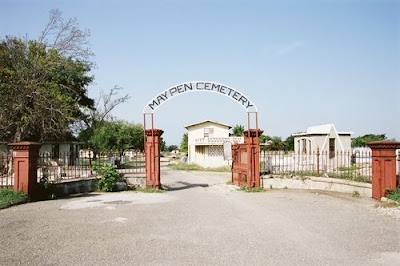
One of the largest nondenominational cemeteries is the May Pen Cemetery, in Kingston, pictured below.
This cemetery, one of the oldest public cemeteries, has become very rundown and neglected, but efforts have been made within the past two years at cleaning it up. As far as I know this cemetery has not been recorded.

Madeleine Mitchell, in her book, Jamaican Ancestry: how to find out more (2008) comments on how dilapidated the various cemeteries of the island have become. Stones are almost illegible, cemetery plots are overgrown, and it's not unusual for people to take up residence in the cemetery or to allow their animals to graze there! Such, I understand, has been the case with the cemetery of the Kingston Parish Church

where higglers have set up shop. Similarly, I am told one should not wander through the churchyard of St. Andrew Parish Church, Half-way Tree without an escort!


Donald Lindo has collected over 7000 burial records of St. Andrew Parish Church covering 1657 to 2000, and these can be found on his CD, Genealogy of Jamaica, 2006. Thanks also to Donald I have a photograph of the grave of my Great uncle, Joseph Rodrigues Da Costa, who is buried in Calvary Roman Catholic Cemetery.

I wish there was a genealogical society in Jamaica which would take on the job of recording our cemeteries before they are all completely lost!

Before I close, I would like to mention that my blog has received an award from another blogger, Jacqueline Smith, who also writes a Jamaican blog, Jack Mandora's, a book-lover's nook. The award is the Arte y Pico Award, and I display it here with pride! Thanks, Jacqueline!

Saturday, 8 November 2008

Lest We Forget -- A Tribute to Those Who Served in the Great War

"They shall grow not old, as we that are left grow old;
Age shall not weary them, nor the years contemn;
At the going down of the sun and in the morning
We shall remember them. " -- Lawrence Binyon

The last item in Sarah Letitia Brown's Commonplace Book is a poem of three stanzas, written in my mother's handwriting, and headed "A Tribute to the memory of Victor Dey Smedmore, 1st Life Guards. Killed in action, Jan 29th 1918". At the top of the page she wrote "copy", so I do not believe she is the author of the poem, and I have no idea who that might have been.


The poem begins:

"We lift the voice lamenting from afar, while memory backward wends through buried years ..."

In my last post I had mentioned that I would comment on the contributions made by my grandfather to the commonplace book, but as November 11th comes closer I felt it was more appropriate to write about my uncle Victor and his sacrifice in the First World War, as well as the sacrifices of other Jamaican men who served in that conflict.

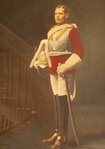
The very first post I did for this blog was about Victor. He was the eldest son of William Dey Smedmore and his wife, Amanda. He was born in 1886 in Port Royal, moved with the family to Kingston, and worked at D. Henderson and Company. He went to England in 1915, joined the First Life Guards, went overseas to France where he was wounded twice, and was killed in action January 1918. I often wondered why he decided to go to England to enlist when he could have enlisted in the West India Regiment but apparently there was a contingent of Jamaican men who did go to England for this purpose. The Gleaner reported on some of them on June 7, 1915:The men listed in the above Roll of Honour were members of the Kingston Parish Church, but there were apparently many more who went to England to join up. My curiosity was aroused as to when Victor sailed for England and thanks to new data on the subscription genealogy database, Ancestry, I found his name on a ship's manifest, that of the ss Coronado, sailing from Kingston to Bristol, arriving at that port on August 15th, 1915.

The names are a bit small to read so here they are:

-- Lester Cecil Jacobs; Karl Everard Laidman; L. Cochrane Shackleton; Huntley Hearne; Maurice Hearne; Victor Dey Smedmore; Alfred George Ayers.

Now, these names mean nothing to me, except for Victor's. It was apparent that they had all seven travelled together on the same ship with the same intent in mind. My question was, had they all enlisted when they got to England? I therefore began a search for the other six. The first source I checked was the Commonwealth War Graves Commission, in the assumption that some of them might, like Victor, have been killed in the War.

The first one I searched for and found there was Karl Everard Laidman, the son of Herbert Edmund and Mary Jane Armstrong Laidman of 65 Norman Road, Kingston, Jamaica. Karl was a private in the Royal Fusilliers, aged 19, and he was killed on March 31st, 1916, a bare eight months after he arrived in England to enlist. He is buried in Lapugnoy Military Cemetery, Bethune, France.

Karl was not the only casualty of that group besides Victor. I also found an A. G. Ayers on the Commonwealth War Graves Commission website, a trooper in the 2nd Life Guards, who died 26 February 1917 and is buried in St. Sever Cemetery Extension, Rouen, France. What then of the other four?

I then searched the online edition of the Jamaica Gleaner to see if I could find any trace of them and I managed to find two more -- Lester Jacobs and Huntley Hearne. Both items were obituaries. Lester Jacobs died March 25th, 1971, at age 83, so I assume he was the Lester Cecil Jacobs listed on the ship's passenger list, though his war record was not mentioned. The obituary, which is brief, mentioned that he was the retired manager of Jamaica Retreading Company and that he was survived by a brother, Caryl, of Miami, Florida and other relatives. Huntley Hearne died April 13, 1964 and his obituary states that he was a "70-year old hero of the 1914 war and an acknowledged artist in the American advertising field". Huntley Hearne had been attached to the Royal Fusilliers and had been awarded the Military Medal for destroying a German pillbox.

I found a few references to Maurice Hearne, who I assume was Huntley's brother, mainly to do with his career as a cricketer. It would seem, then, that he also returned safely from the war. The only one that I could find nothing definitive about was L... Cochrane Shackleton. My searches in the Gleaner brought up articles on a Dr. T. F. Shackleton but this didn't seem to match the Shackleton on the passenger list ... then I noticed that his age was given as 42, whereas the other six men were all younger, between 18 and 29. Was this the doctor? It doesn't explain the differences in first names yet the Gleaner of September 25th 1916 noted that Dr. T. F. Shackleton had been posted to England to the Royal Army Medical Corps. I'm afraid this will remain a mystery!


"But where our desires are and our hopes profound,
Felt as a well-spring that is hidden from sight,
To the innermost heart of their own land they are known,
As the stars are known to the Night;
As the stars that shall be bright when we are dust,
Moving in marches upon the heavenly plain;
As the stars that are starry in the time of our darkness,
To the end, to the end, they remain." -- Lawrence Binyon

Sunday, 19 October 2008

The Commonplace Book -- the Contributors

It's been some time since my last post and I still want to continue with the story of my great-grandmother's commonplace book. However, first of all I want to mention a rather unpleasant comment I received on one of my earlier posts, in which I described going back to 5 Holborn Road in Jamaica. The person who left the comment did not identify themselves. Here it is:

"Where are all the black people?! Are you too good for them huh woman!! your despicable you old saggy lady!! "

Apart from the offensive nature of the comment I'm particularly incensed by the suggestion that I'm a racist. What Anonymous doesn't want to admit is that we Jamaicans are a mixture of all races and colours. Surely this is what the Jamaican coat of arms represents!
Out of many, one people ... I myself am a mixture ... Take my father's family for example! His father was a French Jew from Bas-Rhin, Alsace; his mother, though Catholic, was the daughter of a Sephardic Jew whose family, the Rodrigues Da Costas, I have managed to trace back to 1740. On my mother's side I am the product, I am sure, of both slaves and slave-owners, though it has been difficult for me to go back far enough to find the records that document this. Jamaica is home to people from all over the world and of all shades. Those of us whose families have lived there for a long while are the products of slavery, whether we wish to admit it or not. Thus I take exception to the above comment. I write about my family as I know it, based on my research.


Now, back to Sarah Letitia Brown's commonplace book. My great aunt, Susan Saunders Brown, the eldest of Sarah Letitia Brown's children, wrote four love poems in her mother's book. I have not been able to find their derivation, so for all I know they may be original. Here is one, titled " Love and Physic", and in brackets, "Leep[sic] Year", signed SSB, and dated 1.11.80.


Susan married a widower, John Cassis, on October 17th, 1883. John's first wife, Christiana Augusta Breckenridge, had died of cancer in 1880. Another of Susan's poems, also dated 1.11.80, is titled "Sympathy" and I wonder if it was directed to John. Did her commiseration for his loss eventually lead to love and then marriage? He was much older than her, aged 44 at their marriage while she was only 23. John already had a family of five children by his first wife. The eldest, Catherine, was a year older than Susan. Susan and John between them had four children, two of whom died young, and it seems that Susan did not get over the loss of her youngest, Laura, who died at five weeks, in 1891. Susan died in the Lunatic Asylum, now known as Bellevue Hospital, in November 1899. She may well have been suffering from depression as a result of the loss of her youngest child.

Susan and John's second son, John Madison Cassis, emigrated to Toronto, Canada where he married Fanny Stevens, of Todmorden, Ontario. They had seven children. Here is a picture of John in his garden in Toronto, with his next-door neighbour. John is on the left.

In my next post I'll mention a few other contributors to the commonplace book, one of them my grandfather, William Dey Smedmore.

Arras Memorial

Arras Memorial

Trooper Victor Dey Smedmore

Trooper Victor Dey Smedmore
My uncle Victor