Wednesday, 24 October 2007

A Month in the Country -- part 2

My summer holiday would start the moment the car climbed the hill from Vale Royal up to the house at Friendship. Actually, there were two houses at Friendship. Uncle Rodney's house was at the top of the hill, and at the bottom of the hill was the Nash's house, where Len Nash, his wife Daphne (formerly Newman) and their three children, Dennis, Richard and Arlene, lived. Len Nash was an engineer at Vale Royal and first cousin of my Aunt Marjorie, Rodney's wife. I wish I had pictures of the two houses, because I find my memory is not as clear about what they were like inside as I would wish. Uncle Rodney's house was built up off the ground so that there was a sort of above-ground basement underneath where he had his office and made his various liqueurs (more of that later), as well as where the generator was installed. This was known merely as the Delco, and in fact I went through life for the longest time thinking that was what all generators were called. The Delco provided power when the electricity went off, as it often did.

I have a painting, given to me as a wedding present, and painted by yet another Nash, Sylvia Nash the artist, which immediately brings to mind the end of the property where I used to go and walk away over the rolling countryside, accompanied by the two dogs, Jill, a black Lab, and Bessie, a cairn terrier. Here is the picture.

In my imagination just over that hill I would go off with Jill (Bessie being more of a house dog wouldn't go that far with us), and the two of us would walk along the paths by the cow ponds, where I would skip stones and Jill would go in for a swim. Finally, I would go back home ... Jill didn't always come with me, but would return at her leisure.

I remember a guinep tree on the property. The guinep tree (Melicoccus bijugatus) according to Olive Senior's Encyclopedia of Jamaican Heritage, is a large tree bearing small, round, green-skinned fruit which grow in clusters like grapes. Here is a picture of the fruit of the guinep:

The fruit is sweet and juicy with a seed in the middle and I remember, on one my visits to Friendship, gorging on them one day. That night I awoke feeling quite ill and proceeded to be very sick indeed, much to the disgust of my brother, Mickey, who was sharing a room with me at the time. (I don't recall why, but I guess my parents were also there and we had a full house.) I learned my lesson about eating too many guineps!

The highlight of my holiday at Friendship was going to the beach to swim. Not that I was a good swimmer, and it didn't help that Mickey used to duck me in the water. We went to Derby Beach (pronounced Darby), not far from Duncans. This was a lovely white sand beach with a gradual slope out into the sea. Here is a photo of my Aunt Marjorie at Derby Beach.

and one of Rodney, with the Burke family.

Derby Beach is now the famous resort, Silver Sands, and now looks like this:


My Uncle Rodney was a sugar technologist at Vale Royal Estate and as a hobby he made the most wonderful liqueurs. He made a creme de cafe, a creme de cacao, and incredible orange liqueur and best of all, a pimento dram to die for! Pimento dram is made from the fruit of the Pimento or allspice (Pimenta dioca). Olive Senior in her Encyclopedia of Jamaican Heritage notes that the pimento is Jamaica's only indigenous spice. He never made a commercial venture of this hobby, but rather would bottle enough to give away each year as Christmas presents to friends and family. On one occasion he told me that he had been approached by Dr. Kenneth Evans who was also experimenting with a coffee liqueur, to invest in Dr. Evans's project. Rodney declined and Ken Evans went on to develop Tia Maria, and the rest is history!

Another one of my memories of Friendship is of Rodney's collection of books of Punch cartoons. He had bought them, I believe, from a bookseller on a trip to England, and I would spend hours going through them and reading all the cartoons by famous illustrators such as George DuMaurier. One of my all-time favourites is DuMaurier's cartoon, "True Humility", also known as The Curate's Egg. Who can forget the wonderful caption:

Right Reverend Host: "I'm afraid you've got a bad egg, Mr. Jones"

The Curate: "Oh no, My Lord, I assure you! Parts of it are excellent"

Sadly, Rodney had to get rid of all his Punch books due to an infestation of insects which ate their way through the books. To use an old Jamaican expression: "Chi-chi nyam it"

Friday, 5 October 2007

A Month in the Country

One of the pleasures that I looked forward to each summer holiday was going to spend a few weeks at Duncans, Trelawny, with my Uncle Rodney and Aunt Marjorie. They lived at a house on a hill, not far from Duncans, called "Friendship". My uncle, Rodney Smedmore, was a sugar technologist who had worked at various sugar estates in Jamaica. Some time after he got married he went to work for Arnold Muschett at Georgia and Vale Royal Estates in Trelawny.


Arnold Muschett was born St. Elizabeth in 1882 and married Amy Houchen in 1909. Although they had no children they were both very involved in several charitable bequests for the children of the area including several scholarships, and they donated 25 acres of land for the erection of a school in Wakefield. My thanks to Donald Lindo for the photo and information about Mr. Muschett.

According to Inez Knibb Sibley's book, Dictionary of Place-Names in Jamaica (Kingston: Institue of Jamaica, 1978), Vale Royal in Trelawny consisted of a number of small estates including Georgia, as well as others that I'm not familiar with.
This old postcard of Vale Royal Estate probably dates from between 1910 and 1913. Uncle Rodney would also go quite often to Long Pond Estate, as well as Vale Royal and Georgia. The Great House at Georgia was very beautiful and we would often go to visit the Muschetts there.

My memories of how I actually travelled to Trelawny from St. Andrew are somewhat vague. Sometimes we went by car when Uncle Rodney came up to town to fetch me and we would drive the route from Kingston through Spanish Town and Bog Walk (over the scary Flat Bridge),
on to Linstead and Ewarton, over Mount Diablo... a steep, winding, narrow road over the mountain... then down through the green pastures of St. Ann through Moneague and Walkers Wood, towards Ocho Rios, then along the coast road through St. Ann's Bay, Runaway Bay, Rio Bueno,and then to Duncans. From there we climbed a hill on a marl road which eventually took us to "Friendship".

Once or twice, though, I would travel by train, probably accompanied by my mother. We would board the train in Kingston at the railway station

and then begin the exciting trip going through places with strange and exotic names -- Balaclava ... Maggotty ... Catadupa ... Montpelier ... Anchovy ... ending up at the station in Montego Bay. The train would probably have looked something like this:
Olive Senior, in her excellent book, The Encyclopedia of Jamaican Heritage (Red Hills: Twin Guinep, 2003), reports that early travel on the train one way from Kingston to Montego Bay could take an entire day. I know that we always packed a lunch! By 1952 diesel rail service was instituted and the round trip between Kingston and Montego Bay could be done in a day. In September 1957 a horrendous accident on the railway line at Kendal caused the deaths of 175 people with 400 people injured. You can read about it at the Jamaica Gleaner's Pieces of the Past. Rail service was ended in 1992, after running for 150 years.

More often than not, however, we would travel by car. Going over Mount Diablo was the highlight of the trip. Since one could not see around the hairpin bends it was necessary to blow the horn loudly at every curve. All along the way we would pass vendors selling fruit
and we would stop to buy oranges and mangoes in season. I remember that my poor mother suffered terribly from car sickness and we had to stop a few times along the route when she felt ill.


But at last we would arrive at "Friendship" and the holiday would begin. Next time I'll write about what it was like to be in "the country" ... so different from my life at 5 Holborn Road.

Monday, 17 September 2007

About My Uncles -- part 3

And now to the two youngest Smedmore boys, my uncles Lucius and Julian. My Uncle Lucius was born at 49 Beeston Street on 18 November 1899, the eighth child of William Dey Smedmore and his wife, Amanda. I have only one photograph of my Uncle Lucius, not a very good one ... probably a passport photo. Here it is:


He had apparently sent the photo to his cousin, John Cassis in Toronto, as on the back of the picture he had written:

"This is a recent snap but I don't think the photographer has done me justice. You know, John, I was never half as ugly. Best love to Fanny, yourself and the family, from Maysie and self, Lucius".

Maysie was his wife ... more of that in a moment. My grandfather would have been sixty-three when Lucius was born, and sixty-seven when Julian, the youngest, was born four years later in 1902. It boggles the mind to think how difficult it must have been for these younger brothers to have a father who was old enough to be their grandfather. And when he died in 1914, Lucius would have been fifteen and Julian just eleven. I think they were probably brought up more by their older sisters and mother as my grandfather was not a well man in his latter years, suffering with serious migraine headaches which may well have been the pre-cursor of the cerebral haemorrhage which killed him. I remember my Uncle Rodney relating how they had to keep quiet most of the time because of his father's headaches. Rodney, apparently, loved to build things and was hammering together a chicken coop when told to stop because his father couldn't stand the noise. He was somewhat resentful about that, I remember.

But back to Lucius. Like other members of his family he was a Freemason, a member of St. John's Lodge, and he also worked for Henderson & Company, eventually becoming secretary of two of their sugar estates Orange Valley and Georges Valley in Trelawny. (When I visited Jamaica in 2003 I spent an afternoon at Orange Valley and saw the ruins of the old sugar factory and slave hospital. I also saw the paw-paw grove at Georges Valley. Paw-paw, aka papaya is now a popular export fruit.) Here is a picture of a section of the grove:


Lucius married quite young by Smedmore standards, when he was twenty-four, to Carrie May Burke, the daughter of Aubrey Mapletoft Burke and his wife, Amy Ann Depass. Maysie was three years younger than Lucius. From what I've been told there was some opposition to the marriage from Lucius's mother and two older sisters but he was determined to get married. The marriage was written up in the Jamaica Gleaner and was apparently considered quite the event of the season. Rodney was best man and Lucius's brothers, Owen and Julian, were ushers. The ceremony was performed by the then Bishop of Jamaica ... not surprising as Lucius, like all the Smedmores, was a pillar of the Kingston Parish Church and in fact was a member of the Parish Church Committee.
Lucius and Maysie had two daughters, Marjorie and Gloria, both of whom were quite a bit older than me so we were not very close as cousins. Unfortunately, the marriage ended in divorce in 1956, though they remained friendly and Lucius went to live with Marjorie and her husband, Eric Crawford on Trafalgar Road. It was there, in May of 1963, that Lucius was brutally murdered by a thief. He was alone at the time, as Eric and Marjorie had gone on a holiday to Mexico. The murderer was eventually caught, confessed, was tried and found guilty, and hanged. This event was a tragic one in the family. At the time my parents were visiting me and my family in Winnipeg where we were living, and it was a tremendous shock to them. Worse was to come later that year when my brother, Micky, died of a cerebral haemorrhage in October.

And now to my Uncle Julian, the youngest of the family, the apple of his eldest sister's eye, as I was told. He was different from the others, a very volatile person, someone who had strong likes and dislikes, and in fact, the only uncle that I ever had a falling-out with. He was quite the sportsman. He played cricket and was a member of several clubs. Unlike the others to the best of my knowledge, he did not become a Freemason, but he was a staunch member of the Kingston Parish Church and was a lay delegate to Synod for many years. He was always perfectly turned out in his dress and affected a very British accent, though he would, at times, lapse into Jamaican patois. He was known, affectionately, by family and friends as "The Count".
He married, somewhat late in life at age fifty, Enid Neilson, the daughter of the Reverend Christopher Charles Neilson, a Methodist minister. They were married in Lyndhurst Methodist Church in 1953 and the reception was held by my parents at 5 Holborn Road. To the best of my knowledge Julian continued to attend Kingston Parish Church while Enid remained a Methodist.
I mentioned having a falling-out with Julian. It was some months before my wedding in 1957. I had had an emergency appendectomy and was at home on sick leave, feeling rather sorry for myself, as my mother was in Toronto at the time visiting my brother and his wife and their new baby. I was invited by Julian's sister-in-law, Ruby, to visit her family in Morant Bay. Unfortunately, Julian had quarrelled with Ruby's husband, Edward, and he informed me that "no niece of mine will visit these people, since I have quarrelled with them". I wasn't about to take this interference in my life and we had a fierce quarrel and did not speak for almost six months. I seriously considered uninviting him to my wedding but cooler heads prevailed ... my mother told my I could not do that! ... and we made it up. For all his peculiarities he was a very affectionate uncle. He and Enid had a volatile relationship, but when she was struck with a massive stroke which left her unable to speak, he was devastated, even more so when she died shortly afterwards.
This is a photo of the two of them taken in happier times:

Monday, 3 September 2007

About My Uncles -- part 2

I have just returned from a wonderful twelve days in Newfoundland. I felt a real sense of belonging while I was in that rugged island. Perhaps it was the fact that I too came from an island and was going to another island, a unique place in this vast country. But, more than that, Jamaica and Newfoundland have much in common ... they gave us the cod which we make into our salt fish, and we gave them the rum, which they made into their Screech. The cod fishery in Newfoundland is no more, but that connection still remains.

But back to my uncles. The younger three, Rodney, Lucius and Julian, unlike their three older brothers, all married, two of them somewhat later in life. My Uncle Rodney was born in 1896, a little less than two years after my mother, and the two of them were very close. Rodney was both my godfather and my favourite uncle.

He was a sugar technologist by profession and this took him to various sugar estates on the island. Here is his entry from the 1940-46 Who's Who Jamaica:

Before Rodney married Marjorie Nash he was engaged to be married to Olive May, a teacher at St. Hilda's Diocesan High School in Brown's Town. I remember meeting her once when she came with Rodney to our home at 5 Holborn Road , and I distinctly remember that she told my mother that she should send me to St. Hilda's when I was old enough to go to high school (I was then at the Cunningham's Preparatory School on Surbiton Road). The realization that this would mean leaving my home and my parents to go as a boarder far away in Brown's Town terrified me. Some time after that Rodney informed the family that his engagement had been broken off. My mother was quite upset about this for a while, whereas I felt an overwhelming sense of relief that I wouldn't be heading off to parts unknown to boarding school.

Looking back now, I see was that I was somewhat unfair to Olive May.Thanks to Donald Lindo I now know more about her and also have a couple pictures of her. She was born in Portsmouth, England, in 1917 and received her B.Sc in Mathematics from London University, as well as a Diploma in Education from the University of Hull. She came to Jamaica in the late 1930s and began her teaching career there at St. Hilda's.


I don't know how she met Rodney ... he was probably working in the area at the time. It is unfortunate that their engagement did not last, and I never knew the reason why, but I rather think that the disparity in their ages and temperament may have had something to do with it. From what I've been told Olive was a lively and adventurous woman with a brilliant mathematical mind, but she was also twenty-one years younger than Rodney. I hope that they parted amicably. At any rate, Rodney married Marjorie Nash in September of 1941 in Sav-la Mar. I was a train-bearer at this event. Marjorie's sister, Hazel, was bridesmaid and my Uncle Owen was bestman.


Here I am standing in front in the middle. I must say we all looked pretty solemn, except for the bride and groom who are looking lovingly at each other.

Olive May married Leslie Kensett, a British Army officer, in 1945. They returned to England, but the marriage was not a success and Olive came back to Jamaica where she resided until her death in 2000. She taught at St. Hugh's High School in Kingston, where she was much loved and was Head of the Math Department, until she left to go to Queen's High School for Girls in 1958 as Head of the Math Department there. She was universally loved by all her pupils and renowned as an excellent teacher. Looking back now I feel that she had my best interests at heart when she suggested I be sent to St. Hilda's, but I was only six at the time and didn't want to leave my family.

Rodney and Marjore were happily married for twenty-eight years until her premature death at age 59 in 1969. She had been a diabetic from her early twenties, as a result of which they had no children. I loved her dearly and still miss her. I plan to write more about both of them in future posts.

In my next post I'll write about my remaining Smedmore uncles, Lucius and Julian.

Thursday, 16 August 2007

About My Uncles

In my last post I mentioned a picture which hung in the dining room of 5 Holborn Road, of the Princes in the Tower. Our picture was a black and white print, not colour like the one above, and below the picture were these lines from Richard III, as spoken by Queen Elizabeth:

"Pity, you ancient stones, those tender babes
Whom envy hath immured within your walls!"

'Envy', in this case, personifies Richard III, the quintessential wicked uncle, at least as Shakespeare portrayed him. Personally, I belong to the revisionist school of thought which believes that Richard received a bum rap. Read Josephine Tey's wonderful novel, The Daughter of Time, and check out the Richard III Society of Canada, who each year on August 22nd, place an In Memoriam notice for Richard in the Globe and Mail. In case you're wondering why I'm mentioning this, it's because my daughter asked when I was going to write about "the wicked uncles". Well, I had no wicked uncles. They were all regular uncles ... each with his own foibles and peculiarities, but nothing out of the ordinary, except, perhaps, that the eldest three never married.

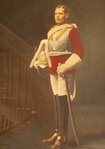
My very first post was about my Uncle Victor, the eldest of the Smedmore boys, who went to England in 1915 and joined the Life Guards of the Household Cavalry, was sent to France with the combined battalion of the Reds and the Blues which made up the Household Battalion of the British Expeditionary Force, and was killed in action in 1918. I never knew him of course, only what my mother would tell me about him, and what little information I found about him in the online Daily Gleaner, which reported on his joining up and on memorial services held after his death. The only picture I have of him is a large framed painting , which may have been a photograph which was colorized, showing him in his Lifeguard uniform.


I remember another picture of him, at 49 Beeston Street, one of a group of three soldiers in their khaki uniforms, but I have no idea where that picture ended up.
Victor was born in February 1886, and the next son, Norman, was born the end of November 1887. He is another uncle that I never knew, and in a way he's the real mystery man of the family. He doesn't seem to have been as popular with his sisters as was his older brother ... but then, getting killed in the war does give one a certain cachet. Norman, known by the family as Normy, also left Jamaica, but not to fight. Like many other Jamaicans he headed off to New York in June 1918, on board the ss Zacapa. On the ship's manifest he gave his next of kin as his mother at 49 Beeston Street, and stated he was going to stay in New York with a friend, Joseph Levy. Joseph Levy was the youngest brother of my father and had himself left Jamaica for New York in August 1917. Norman claimed on the manifest that he was going to the U.S. for six months but he certainly never returned to Jamaica. He lived there until his death in July 1953. I have no photographs of him and all I know of him is what I've been told by my mother, and what I've been able to find out through research. He settled first in Brooklyn where he worked as a traffic checker for the Public Service Railroad Company, and in September 1918 he filled out a registration card for the draft. After that he appears to have worked for the rest of his life in New York for Swift & Company, meat packers. Thanks to David Priever, a researcher in New York, I was able to get a copy of the administration of his estate from the Surrogate Court of New York ... like many of the Smedmores, he left no will ... and what ever else I know about him comes from this brief obituary in the Gleaner of August 8, 1953. That Norman was a Freemason doesn't surprise me as my grandfather and my Uncles Rodney and Owen also belonged to the Scottish Rite. I had not known that, like Victor, he attended Wolmer's Boy School, nor that he had worked for the lumber companies in question. I do know, from what my mother told me, that he would send money home for his mother and sisters, and I know, from a brief notice in The Gleaner that Elma went to New York on vacation in June 1951,so I imagine she must have visited Norman. One thing I do remember is how surprised the family was at how small his estate was -- according to the lawyer, Albert Stark, a mere $4,400. Considering that Norman never married, lived in lodgings and had worked steadily since arriving in New York, this small amount to be divided between his siblings, after all expenses had been paid, came as quite a shock.

I come now to the Smedmore uncles that I did know. The next one in the family was my Uncle Owen, born in November 1891 in Port Royal. To my mind he was the best looking one of the family and it always puzzled me that he never married.


I think one reason may have been that he had a speech impediment, a stammer, as did Rodney and Lucius, though I remember that Owen's seemed to be the worst of the bunch. There are probably all sorts of scientific reasons for speech impediments, but I feel pretty sure, from what my mother told me, that this was exacerbated by my grandfather's treatment of his sons. He had no patience when they stuttered and would tell them to speak up without stammering. I think Owen was probably shy. He worked all his life at D. Henderson and Company at the corner of King and Harbour Streets.

I remember him as gentle and generous. I could always touch him up for money at Christmas time when all the family gathered at 5 Holborn Road -- two shillings and sixpence or even five shillings, and then, of course, I would go to the other uncles and tell them how much I got from Owen, and they, not wanting to be outdone, would shell out as well.

I guess Owen felt he had an obligation to take care of his mother and sisters, once Victor had left for the war and Norman had emigrated to the States, consequently he lived at home with them, first at Beeston Street, and then later he moved with my aunts to 11 Dunrobin Avenue when the Beeston Street house was sold. I would say he had a very powerful sense of duty to his unmarried sisters and I know that he was a loving brother and brother-in-law. Sadly, he was on holiday when he died. The family had gone to White River for a vacation when Owen suffered a heart attack or a stroke while swimming.

In my next post I'll write about my other uncles, Rodney, Lucius and Julian. It may be a while as I'll be off line while on vacation for two weeks.

Arras Memorial

Arras Memorial

Trooper Victor Dey Smedmore

Trooper Victor Dey Smedmore
My uncle Victor