Monday, 12 November 2012

A Jamaican Childhood -- My Early School Days


I was probably about five or six years old when I first went to the Surbiton Preparatory School, at 7 Surbiton Road, St. Andrew.  The school was held in the home of Mr. and Mrs. Arthur Cunningham and was operated by two of their daughters, Miss Linda and Miss Ivy. Another daughter, Miss Sybil, taught music, and I was to become one of her pupils as well.

This is the earliest advertisement I could find for the school in the Jamaica Gleaner of April 1942:


Miss Linda and Miss Ivy seem to have taken turns for the position of Headmistress as later ads name Miss Ivy in that position.

The house at 7 Surbiton Road stood on a large portion of land, similar to many houses of that age in St. Andrew. I remember that in the garden there was a large summer house completely overgrown with trumpet vine, campsis radicans.

Classes were held in the large dining room and the living room, though that was reserved in the afternoons for the Surbiton School of Music, under Miss Sybil’s instruction  As a child I took part in the percussion band. Here is a photo of the band

The photograph was taken on the front lawn, and one can see in the background, the house which belonged to the family of Noel Fraser, located opposite 7 Surbiton Road. I don’t recall the names of all the children in the photo.—Dennis Brennan is on the extreme left, playing the drum, and his sister, Sheila, is fourth from the left. I am fourth from the right, playing the tambourine, with Clare(Tinka) Taylor on my right, and her younger sister Rosemary (Bidi) on the extreme right.  The conductor is Michael Bronstorph, the son of Dr. Bronstorph whose home was on Trafalgar Road, almost opposite to Holborn Road.

Among my photographs is one taken of what appears to be a school pageant in honour of our British heritage. We dressed up in various costumes representing the different cultures which made up the British Isles


Beverly Webster and Joanne Surridge, on either side of the group, represented the British Navy. Hazel Aird, Lena Negretti and Michael Bronstorph, decked out in kilts, were the Scottish contingent. Heather Aird, and a child whose name I have forgotten, were the Irish representatives, and myself, to the right of Joanne, and another child were togged out in Welsh costume. As you can see, from the scowl on my face, I didn’t really appreciate the tall hat. Towards the centre little Toni Negretti appears to have been some sort of fairy. It’s interesting to me now to realize that the African history of Jamaica was totally ignored in this pageant.

In looking through some of my old documents I came across the certificate and marks I earned for my Grade II Piano exam back in April 1946.  I actually made the Gleaner, along with the other successful members of Miss Sybil Cunningham’s Surbiton School of Music.

I continued to play piano for quite a long time, then got sidetracked to the electronic organ and now, with age, have quite lost my pianistic ability. Still, it’s rather gratifying to look back at my score sheet for Grade II (Elementary) – Pianoforte, and remember that I once “delighted” the examiner with my playing!


Friday, 14 September 2012

A Jamaican Childhood -- Growing Up in the Forties

I was probably about six years old when this photo was taken, in the garden at 5 Holborn Road. I grew up during the Second World War, not particularly aware of the war itself, although my family was. I remember, for example, that at 49 Beeston Street where my aunts and uncles lived with my grandmother, there was a picture of the King, George VI, with an excerpt from a speech he gave in his 1939 Christmas broadcast to the British Empire. He quoted from a poem by Minnie Louise Haskins, “The Gate of the Year” and I distinctly remember these words beneath his photograph in the framed picture:

“And I said to the man who stood at the gate of the year, “Give me a light that I may tread safely into the unknown”.
And he replied”: “Go out into the darkness and put your hand into the Hand of God. That shall be to you better than light and safer than a known way”.

I was four years old when the war started and ten when it ended, and yet I don’t have many memories of life being particularly different because of the war. I believe that there were food shortages, especially of imported goods. I have a vague memory of my mother producing a dessert known as “Patriotic Pudding”, probably because of the few ingredients used to make it, but for the life of me I cannot recall what was in it or what it tasted like, only that we were supposed to feel that we were doing our bit for the war effort by eating it!  Another memory that comes to me is from my school days. Around this time, probably when I was about four or five, I was sent to the Surbiton Preparatory School at 7 Surbiton Road, run by the Misses Ivy and Linda Cunningham. Here is an ad for the school from the April 1942 Gleaner:

Miss Linda and Miss Ivy, as we called them, took it in turns to be Headmistress. I’ll speak more about Surbiton Prep in a future post. My reason for bringing it up is that at sometime during the war the school was moved briefly from 7 Surbiton Road to the home of Dr. and Mrs. Ernest Bronstorph on Trafalgar Road, opposite to Holborn Road. They had a large house with spacious grounds, and I distinctly remember that we, the children, took part in training for possible air raids.

I remember that my brother, Micky, who was eight years older than me, was dead keen to “join up”, until he heard of the death in action of one of his friends who had joined the RAF. Our family knew of at least one close friend who was in the War -- Jack Duffus, who served in Egypt, and sent us this photograph.

 
The photo was signed on the back “In the field …Xmas 1944”. The Duffuses were very close to our family. Jack’s parents, Will and Hetty, were Micky’s godparents, and Jack had been a pageboy at my parents’ wedding.

I have a vague memory that Captain Tame who, with his family lived across the road at 6 Holborn Road, may have been in the Home Guard, but I’m not sure. Frederick Tame, his wife, May and their two daughters, Lily and Violet, were very good friends of our family. Frederick Tame had been an officer in the British Army, and we all called him Captain Tame.
This is a photo of Violet with her father, Captain Frederick Tame, in their garden, with Vi holding their Pekingese.

Looking over this post I realize that my memories of wartime are somewhat indistinct. In fact, I was very lucky indeed to be so untouched by the war, not like children in Britain and Europe. My Jamaican childhood was certainly a blessed happy time.

Thursday, 31 May 2012

All the Sevens ... or Way Past My Shelf Date

I’ve been feeling guilty as I haven’t updated my blog for about four months, and wondered what I should write about next. Well, today is my birthday and I’ve reached the august age of seventy-seven … so I thought perhaps it was time to blog about myself for a change. The first thing to think about was what should I call this post? The title “Way Past my Shelf Date” came to mind, based on that wonderful quote from Psalm 90, verse 10: “The days of our lives are threescore years and ten …” which would seem to suggest that to live beyond seventy is to do so on borrowed time … Which is why I prefer “All the Sevens”. In my teenage years and somewhat later I used to go to the Sergeants’ Mess at Up Park Camp with my pal, Sheila Bewley, whose older sister, Dawn, had married a Sergeant, Andy Taylor, who was stationed there. There we played Tombola, a type of British bingo, which, if I remember correctly went up to 99, and was not played under letters like B I N G O , but had its own language. So 77 was “all the sevens”, 99 was “all the nines”, but 66 was “clickety-click”. 21 was “key of the door” … any number ending in zero was “blind”, i.e. 50 was “blind 50”, yet 11 was “legs eleven”, and so on. Perhaps there are some of you out there who remember all this …


I was born on May 31st, 1935 at Nuttall Memorial Hospital, at Cross Roads, Jamaica

The hospital was founded in 1923 built on land purchased by the Diocese of Jamaica and commemorates the work of the Reverend Enos Nuttall, Bishop of Jamaica, after whom it is named.  My parents, Michael Levy and Maud Smedmore, already had one son, Mickey, born 2 April 1927. They were then living at 7 Anderson Road, Woodford Park. My father was a civil service clerk in the Government of Jamaica. There is a photo of my brother, Mickey, probably taken at Anderson Road

 I have no memory of this place to go on, only the photo.

 When I was six months old my parents bought the house at 5 Holborn Road. I found an advertisement in the Gleaner of 5 August 1935 advertising the house as follows:
 I guess they must have bought the house at that time. It’s the only home I remember. Here’s a photo of my parents with me as a baby in front of the house at 5 Holborn Road --

My earliest memory of my birthday is of my fourth … I vaguely remember having this huge tube, like a very large Christmas cracker, which when opened contained all sorts of goodies. I don’t remember the contents, but I do remember dragging the container around the yard of our home at 5 Holborn Road. Somehow this was much more fun for me than whatever had been inside it.

I remember my childhood as being a very happy one. In a way I was almost an only child, as my elder brother, Mickey, was eight years older than I was and would have nothing to do with me. I realize now that, as the only male child in the family he had been quite spoiled until I came along … My mother’s aunt, Aunt Tess, made much of me and poor Mickey’s nose was quite out of joint, as we used to say. This led, of course, to ill feelings on his part, which I now understand, but did not at the time.

Our family was not that large. There were, of course, the aunts and uncles, all Smedmores, and of whom I’ve written before in my blog. I knew nothing about my father’s family on his mother’s side, the Da Costas, something I have always regretted. On the Smedmore side I had two cousins … daughters of my Uncle Lucius who had married Carrie May Burke, aka Maisie. They were both older than me. There was my cousin, Marjorie

And my cousin, Gloria
Marjorie had been born in 1925, so was two years older than my brother, Mickey, thus ten years older than me, and Gloria was born in 1927,a few months after Mickey. Both of them would have considered me as a mere child, so I really had not much interaction with them. I had another first cousin, whom I never met.  This was my cousin, Walter Berner, the only child of my father’s sister, Essie, who had married Cort Berner, and who lived in the United States. He was known as “Bunky”. I never had the opportunity to meet him, but I have made contact since with his daughter, Cheryl..
In my next post I’ll reminisce some more about my childhood memories.


Sunday, 29 January 2012

In Memoriam, Victor Dey Smedmore

I had intended to return to my post about my grandfather, William Dey Smedmore, but today, January 29th, 2012, is the 94th anniversary of the death of his eldest son, my uncle Victor Dey Smedmore, who was killed in action January 29th, 1918, in France during the Great War.
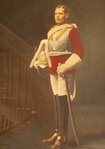
My grandfather, William, died before the War started, on July 2nd, 1914. Would he have been in favour of his eldest son going to England to join a regiment? It’s hard to say. Victor sailed to England with other Jamaicans intent on joining up, as I wrote in a previous post, “Lest We Forget”. Victor joined the Life Guards – the picture of him above shows him in his regimental uniform -- and was sent to France with the British Expeditionary Force as part of the Household Battalion. He was killed in action near Arras on January 29, 1918. The family learned about his death from the War Office by this note which I found in my mother’s papers.
Although the note says that Victor was buried “at a point just North West of Monchy Le Preux, South east of Arras”, he has no known grave. I wrote to the Commonwealth War Graves Commission and received this response from them:
"Trooper Victor Dey Smedmore, 1140, serving with the Household Battalion, died on 29 January 1918... He has no known grave and therefore he is commemorated by name, along with others from his regiment on Bay 1 on the Arras Memorial, France. The Arras Memorial stands in Faubourg-d'Amiens Cemetery, Arras, 2 kilometres north-west of Arras Railway Station and bears the names of over 35,000 men lost without trace during the battles of Arras."

Thanks to the kindness of Rory McGregor I do have photos of Victor’s name on the Arras Memorial as well as pictures of the area around. Here is a shot of the memorial showing Victor’s name,
and another of one of the hallways:
While doing research for a friend in the Jamaica Gleaner, I came across a story of the commemoration of the War Memorial at Wolmer’s School, which Victor had attended and found that his name is also commemorated there. 
The notice is from the Gleaner of November 13th, 1923. The monument, erected by the Wolmer’s Old Boys Association, was designed by an old Wolmerian, Vernon Streadwick, and commemorates those men who attended Wolmer’s who had died in the Great War.

Perhaps it’s as well that my grandfather never knew about the War or the death of his eldest son. In my next post I’ll return to William Dey Smedmore and what I was able to learn about him from stories in the Gleaner.

Friday, 9 December 2011

The Smedmores of Port Royal

William Dey Smedmore and his family lived in Port Royal until about 1896, probably on a street very much like this one pictured above. In fact, they lived at two different addresses according to the records I have found. But I’m getting ahead of myself here. Let’s begin with his marriage, as I know very little about him prior to that event.

William married Amanda Brown at the Kingston Parish Church on 6th December 1882. He was a bachelor, aged forty-four, and gave his occupation as writer, H. M. Dockyard. Amanda was a spinster, aged twenty-one, no occupation. Both gave their abode as Port Royal. William gave his father’s name as William Dey Smedmore (dead), and Amanda’s was given as Daniel D. Brown.  They were married by the Rev. G. W. Downer, and the witnesses were B. Mortimer Dias and C. L. Cunha.

Well, there are a couple of problems with this record. No record has so far been found for William’s father, so we cannot be sure that this was indeed his name. Secondly, Amanda’s father’s name was Daniel Elias Brown, so the middle initial “D” is incorrect.  Another oddity is my grandmother’s age. I don’t know if my mother ever saw this marriage record, because, curiously enough, she always claimed that her mother’s birth date was 10 July 1864, and that she was actually only eighteen when she married William. However I have found the record of Amanda’s baptism in the Wesleyan Methodist church, in Jamaican Family Search, and she was definitely born on 9 August 1861, which would agree with her age at marriage. It seems odd to me that my grandmother’s children had a completely different date for her birth, not just a different year but a different month and day!

William’s occupation of “writer in H. M. Dockyard” was also puzzling. I discovered that a writer was  a clerk, a civilian employee in the Royal Navy, at the Dockyard in Port Royal. William’s close friend, George Christopher Baylis, who was a  connection through marriage to his wife’s half-sister, was also a writer at the naval yard.

The first three children were born at
Sime Street
in Port Royal. According to the birth records the two eldest, Sylvia and Victor, were born at no. 2 Sime Street, in 1884 and 1886 respectively, and the third child, Norman, was born in 1887 at no. 1 Sime Street. Shortly thereafter they moved to Fishers Row. I came across a brief note in The Gleaner of 1st May 1888 which mentioned this move.

So it appears that the Smedmore home was to be taken over to be used as barracks for the Army. Might this have had something to do with a story my mother told me about her older brother, Victor? As a young child he had reported seeing a soldier in military dress walking up and down the balcony or piazza of the house they were living in. The tale was that the house had been a barracks and that Victor had seen a ghost. Victor would have been about two years old at that time. It’s possible he saw a real soldier if military personnel came to the house to inspect it prior to taking it over.  At any rate the family moved from there to Fishers Row where the next four children were born – Elma in 1889, Owen in 1891, Maud in 1894 and Rodney in 1896. Then, some time after this they removed to Kingston where the last two children were born – Lucius in 1899 and Julian in 1902.  By 1896 William Dey Smedmore was sixty years old and had retired from his position at the Dock Yard. The family settled down in a large house at
49 Beeston Street
and I have written about that house in a previous post.

In my next post I’ll relate the stories I heard about my grandfather from my mother, as well as a few other items I found in The Gleaner  about him … gold to the enquiring genealogist!

Arras Memorial

Arras Memorial

Trooper Victor Dey Smedmore

Trooper Victor Dey Smedmore
My uncle Victor