Monday, 7 July 2008

Coming to America -- Uncle Joe and Candid Camera

Do you remember this catchy little theme song?
When it's least expected - you're elected. You're the star today
Smile! You're on Candid Camera!
With a hocus-pocus - you're in focus. It's your lucky day
Smile! You're on Candid Camera!

It's fun to laugh at yourself. It's a tonic, tried and true.
It's fun to laugh at yourself as other people do.

How's your sense of humor? There's a rumor: Laughter's on its way.
Smile! You're on Candid Camera! Smile! You're on Candid Camera!

Candid Camera was a really popular show, one of the earliest reality shows, the premise of which was to catch people off guard "in the act of being themselves", as the show's creator, Allen Funt, claimed.
You may also remember Allen Funt's sidekick, Durward Kirby.

Durward Kirby appeared on Candid Camera between 1961 and 1966. I also remember him on the Garry Moore Show and the Carol Burnett Show.
I used to watch Candid Camera while we lived in Winnipeg. We had settled there in 1960 after leaving Trinidad and Jamaica. As I mentioned in my last post, we visited Uncle Joe for a few days en route from Jamaica to Canada. I didn't expect to see Uncle Joe again for quite some time, if at all, until one afternoon in 1964 when I saw him on Candid Camera. There were four vignettes on the half-hour show, and the last one was the one Uncle Joe was on. The set-up was this: Uncle Joe, whose job at the time apparently was to run errands, was called to an office in Manhattan. There, behind a screen, was a man who asked Joe to take his pants to the cleaners, and a pair of shoes to be shined. The trick to this sequence was that the pants had three legs. What Candid Camera wanted to elicit was Joe's reaction to this odd pair of pants.
Well, he looked the pants over carefully. The man behind the screen asked him to check the pockets to make sure nothing was left in them,
and that was when Uncle Joe realized that the pants not only had three back pockets, but had three legs! Uncle Joe, however, did not react right away. In answer to the comments by the man behind the screen he admired the cut and material of the pants, and even the colour, but he did comment that there were too many back pockets. Next the man asked Joe to take his shoes to be cleaned, and proceeded to pass three shoes over the top of the screen -- a left shoe, a right shoe and a middle shoe. Once again, Joe did not react. Then he was asked to call a number to speak to the man's wife, and of course, was connected to Candid Camera. He didn't seem to catch on then, until the man came from behind the screen and told him he was on Candid Camera.

Joe took it well. He laughed and said: "You know what the problem was? You had too many pockets!" And he smiled into the camera.

After I saw the show I wrote to Uncle Joe to ask him if it really was him on Candid Camera. He wrote back to assure me that it was indeed him, but he had a different take on his reaction to the skit, in comparison to comments made by Allen Funt. Funt stated that Joe just didn't want to believe what he was seeing, hence showed no reaction. According to Uncle Joe, he didn't want to embarrass the man who apparently had a pair of pants with three legs.

The last time we saw Uncle Joe was when he visited us in 1973. We were living in Burlington, Ontario by then and my parents had come up to visit us. Joe and Alice took a bus from New York to spend a few days in Burlington and so the brothers were united for the last time. Here they are, with Alice. You can see the strong family resemblance between my Dad and Uncle Joe.

The Watergate scandal was in the news while Joe and Alice were visiting us. I asked Uncle Joe what he thought of the affair and he got very excited about it. I don't know whether or not Uncle Joe was a Democrat, of if he had any political leanings, but he was highly incensed about Watergate and the part played by H. R. Haldenman and John Erlichman.

"Ehrlichman", he said. "Do you know what the name means in German? 'Ehrlich' means 'honest, honourable' ... 'Ehrlichman' means 'honourable man'!"

Uncle Joe died the next year in 1974 of liver failure. Alice, who was eleven years younger than Joe, lived for another thirty years, dying in April 2004 in a nursing home.

Sunday, 8 June 2008

Coming to America -- Visiting Uncle Joe

In April 1960 we left Trinidad to return to Canada, via Jamaica. We flew from Piarco Airport, near Port-of-Spain
and arrived at Palisadoes Airport, near Kingston,
where we planned to stay with family for a week or so before going to Canada. The plan was that we would fly to Toronto via New York and visit my Uncle Joe for about three days. In order to stay even for that space of time we had to get visas from the US consulate.

We flew to New York from Palisadoes on BOAC, British Overseas Airway Corporation, now known as British Air. (The acronym was sometimes humourously rendered as "Better on a Camel", much the same way that BWIA (British West Indian Airways) was known colloquially as "But Will it Arrive" or Better Walk if Able".) I remember that we flew first class, which entailed excellent food served on fine china and complimentary wine and liquor! Ah, those were the days of air travel. We shall not see their like again.

We landed at LaGuardia Airport and were met by Uncle Joe and his wife, Alice. We went by cab to their apartment at 1575 Theriot Avenue in the Bronx.As we had only three days I really wanted to see as much of New York City as I could. Uncle Joe, however, was not that keen on the idea. When I expressed the desire to visit the Empire State Building, his response, in his best Bronx accent, was: "The Empire State Building? That's for hicks!" It turned out that Uncle Joe had never gone there nor had he visited the Rockefeller Centre, the United Nations, or any of those other place the average tourist wants to see. Nevertheless he complied and we travelled by subway and managed to pack in quite a few places of interest.

I had hoped to see my Uncle Leo as well, but that Joe adamantly refused to arrange. He was, apparently, estranged from his brother and would have nothing to do with him. Alice said that Leo had "done something" to Joe which he could not forgive. I had the impression it had something to do with money. Uncle Leo, it appeared, was inclined to frequent the track where he bet whatever money he had on the horses, not always successfully. The impression I got was that Leo, whose occupation was that of master house painter, would work at various jobs in order to make enough money to go to the races. I am sorry now that I did not insist on knowing more about him because I have found Leo to be quite elusive. I cannot find when and how he got to New York, nor can I find him in any census. My searches on Ancestry have turned up only one record for him ... his draft card from the World War II Draft Registration, 1942, known as the "old man's registration" for those born between 1877 and 1897. Here is the front of Leo's card:

On the other side of the card he is described as five ft. 3 1/2 inches tall, 145 lbs., with blue eyes, grey hair and a ruddy complexion, and with a scar on his right wrist. He was then 47 years old, and according to the front of the card, was unemployed. And that's all I know about him.

At the end of our three day visit we left Joe and Alice. Here I am with Alice in the lobby of the apartment building on Theriot Avenue.I should point out that I was then expecting our second child. And here are Joe and Alice at the airport, seeing us off to Toronto.

This wasn't the last time we saw Uncle Joe, but more of that in my next post.

Friday, 9 May 2008

Coming to America -- My Surprising Uncle Joe

Joseph Dudley Levy was the youngest of the Levy family. He may have been the first one to leave Jamaica and go to New York, but I cannot be sure of this, as I have not so far been able to find any record of his brother, Leo's emigration, also to New York. As I mentioned in a previous post, Joe sailed from Port Antonio on board the ss Catherine Cuneo, on August 28th, 1917, and arrived at the Port of New York on September 4th. According to the ship's manifest he was age seventeen, and going to a Mrs. Warner, a friend, at 346 Summer Avenue, Brooklyn, New York. I have no idea who this Mrs. Warner might have been. Under the column "Name and complete address of nearest relative or friend in country whence alien came", Joe listed his mother, Mrs. Alice Levy, 22 Beeston Street, Kingston, Jamaica. Also on the first page of the manifest is a column headed "Race or People". It is typical of the mindset of the American authorities at that time that anyone coming from Jamaica was immediately labelled "African Black". Thus was my Uncle Joe labelled, yet at the same time he was described as fair complexion, with brown eyes and brown hair, and with a deformed right thumb.

What happened to him immediately after his arrival in New York is a mystery, as I have been unable to find him in the 1920 census. However, he does show up in the 1930 census for Manhattan, District 787, as a boarder in a household on 113th Street, headed by one Harry Petrous. It appears to have been some kind of tenement, and also in the same household were two of Joe's cousins, Adwin and Aaron Da Costa, the eldest and youngest sons of Alice's brother, Melbourne Rodrigues Da Costa. But now comes the curious part! For Joe is no longer Joseph Levy, but instead is calling himself Joseph Lavell, and in the column for birthplace he gives the information that he was born in Pennsylvania!

Here I must digress for a moment. I knew that Uncle Joe had changed his name to Lavell -- though whether or not he did it officially is not known. His rationale for doing this was that he would have faced discrimination in New York with a Jewish name, even though he was not Jewish but Catholic. I have a sneaky feeling that the name change may have had something to do with his eventual marriage, though at the time of the 1930 census he was listed as single, and in fact did not get married until 5 June 1937, but it's possible that he had already met his future wife, Alice Savitski, who interestingly enough, was born in Wilkes-Barre, Pennsylvania. Was this why Joe claimed from then on to have been born there?

Joe applied for and received United States citizenship in November 1924. I am very grateful to a researcher in New York, David Priever, who searched for me and found Joe's Declaration of Intention, in which his name is definitely given as Joseph Dudley Levy.

It appears, then, that Joe changed his name some time between his declaration of intention to become a US citizen and 1930 when he was calling himself Joseph Lavell.
I first met my Uncle Joe in person in 1955 when he came to Jamaica for a visit. It had been a very long time since he had seen my father, his brother. I imagine that he knew my mother, since the Smedmores lived across the street from the Levy family on Beeston Street. In fact, when my uncle, Norman Dey Smedmore, emigrated to New York in 1918 he gave Joe's name on the manifest as the person he was going to in New York City. Joe's address at the time was 1121 Bedford Avenue, Brooklyn. Although by now Joe was married he did not bring Alice with him, as she apparently did not like the idea of flying. I remember my Uncle Joe as being very American indeed in accent and behaviour. I know that my father was extremely happy to see him again after all that time.
In my next post I'll write about my visit to New York with my family, when we stayed for three days with Uncle Joe and Alice and got to know him better.

Saturday, 3 May 2008

Father Joseph Dupont's Statue

It's been a while since my last post. A little over two weeks ago I had surgery -- total knee replacement, and so it's slowed me down a bit.

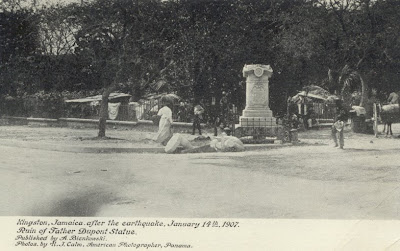
I want to return briefly to the 1907 Earthquake and one of the stories of the quake, the damage to the statue of Father Joseph Dupont. You may remember that this is what it looked like after the earthquake:


The statue was quite badly damaged as you can see. You may also remember that I showed another photo, taken about 1940, showing the statue after it had been repaired.


I didn't give much thought to what had happened in between, such as when was the repair done and how it was accomplished, until, while browsing through Father Francis X. Delaney's History of the Catholic Church in Jamaica, B.W.I., 1494 to 1929 (New York: Jesuit Mission Press, 1930) I came across the story behind the repair of the statue. On page 256, Father Delaney writes:

"Since the day of the great earthquake, January 14, 1907, the pedestal that supported the statue of Father Dupont, had stood empty in the Kingston Parade. It had become a spectacle of the great disaster, as well as of civic neglect and ingratitude. In the course of the year 1924, Mr. Alexander Falla started a movement to have the monument restored. A public-spirited citizen, Mr. S. J. Streadwick, opened the fund, and Mr. James Dunn contributed the substantial sum of fifty pounds. The editors of Catholic Opinion and of the daily Gleaner took up the cause and the result was that about two hundred and twenty pounds were collected from people of every class and creed. The statue was publicly unveiled by the Governor of Jamaica, Sir Edward Stubbs, and presented to the city of Kingston, represented by the Mayor, Honorable A. E. DaCosta, on Sunday, September 11, 1927, the year which marks the eightieth anniversary of Father Dupont's coming to Jamaica and the very day which marks the fortieth anniversary of Father Dupont's leaving his adopted Jamaica for his home in Heaven".

This was indeed an ecumnical effort to restore Father Dupont's statue. S. J. Streadwick, for example, was a staunch Anglican, yet, as Father Delaney writes, people of all classes and creeds moved together to subscribe to the statue's repair.

I'm interested in Father Dupont because he baptized some of the children of my great grandparents, Jacob Rodrigues Da Costa and his wife, Selina Jane Roberts. Here, from Father Delaney's book, is a picture of Father Dupont.


According to a brief story in the Gleaner of January 28, 2007, Father Dupont was born in Savoy, France in 1809, and came to Jamaica as a priest in 1847 where he remained for forty years ministering to the poor and establishing missions all over the island. The original statue to his memory was erected in 1892, by public subscription and the Gleaner notes that Father Dupont was the only clergyman to have a statue erected in his honour in Jamaica, so he must have been universally loved and respected.

Wednesday, 2 April 2008

Remembering My Brother, Micky

If he had lived, my brother Micky would have been eighty-one years old today. Sadly, he died far too young, at thirty-six, leaving a wife and three very young children. This post is dedicated to his memory.

My parents, Michael Leopold Levy and Maud Dey Smedmore, were married April 27, 1926. A year later, April 2, 1927, their eldest child, a son, was born and christened Michael Owen Dey Levy, but known by everyone as Micky. He was the first nephew and grandchild in the family. Although my mother was one of nine Smedmore children, and my father, Michael, was one of seven, their generation had not proved as fruitful. Only two of the Smedmores were married by 1927 -- my uncle Lucius, who had two daughters, and my mother. Two Smedmore men, Rodney and Julian would marry eventually but they had no children. Micky, therefore, occupied a unique place as the first boy in that generation. Here he is with his mother, probably at their first house on Anderson Road:

My mother kept his hair long till he was about two years old, a fact he hated to be reminded of. Here he is again, sitting on the steps of the house at Anderson Road.

My mother did not get pregnant again until Micky was about six, so he was the only child for quite a while and, according to my mother, quite spoilt by his aunts and uncles. My mother had a miscarriage, which was a great disappointment to her, and then shortly after became pregnant with me and I was born at the end of May in 1935, by which time Micky was eight years old. He had been the favourite of my great aunt, Tess, but when I came along Aunt Tess turned all her attention to the new baby and "Micky's nose was out of joint", as my mother put it. This was her explanation for why we were not close as brother and sister, but I think the difference in age had a lot to do with it.

Micky went to school at Jamaica College when Reginald Murray, known as "Reggie", was Headmaster.

I believe he sat the Senior Cambridge Exam but left school without going on to the Cambridge Higher Schools Examination. With the help of a family friend, Cyril Tame, Micky went to work at Barclays Bank in Kingston, where he worked for many years. Men who joined the Bank at that time could expect to be sent all over the island and even to other islands where the Bank had branches, so I did not see much of Micky in this time period. One of his postings was to Trinidad so he was away for some time and there was little chance for us to develop a relationship. In fact, I would have to say that our relationship consisted of a certain amount of hero worship on my part and bare tolerance on his. He was a dreadful tease and would make my life quite miserable at times, so we just weren't that close.

Micky was incredibly popular, however, with his friends both male and female. He was very involved in rifle and pistol shooting and competed in the sport and was also a motor car enthusiast and took part in motor rallies.

One of his favourite sports was hunting alligators,(actually crocodiles), which are now an endangered species in Jamaica, but were fair game back in the forties and fifties. He would tell the story of how, on one of his alligator hunting expeditions, his life was saved by the gristle in his mother's roast beef sandwich. Micky was squatting by the shore, eating his sandwich, and turned to spit out a piece of gristle. There, aproaching him, was an alligator with its jaws wide open. He just had time to grab his rifle and shoot it.

At a time when I was older and we could have developed a closer relationship we were once again separated by circumstances. Micky got married and emigrated to Canada where his eldest child was born. Here he is, with his son, Michael, reading one of his favourite magazines.

By the time he and his family returned to Jamaica it was I who was getting married and leaving the island. We would see each other whenever I returned home for a visit. In 1963, when he died of a cerebral haemorrhage, I was living in Winnipeg. We had never really gotten to know each other as adults, and that is what I regret most of all.

Arras Memorial

Arras Memorial

Trooper Victor Dey Smedmore

Trooper Victor Dey Smedmore
My uncle Victor