Thursday, 16 August 2007

About My Uncles

In my last post I mentioned a picture which hung in the dining room of 5 Holborn Road, of the Princes in the Tower. Our picture was a black and white print, not colour like the one above, and below the picture were these lines from Richard III, as spoken by Queen Elizabeth:

"Pity, you ancient stones, those tender babes
Whom envy hath immured within your walls!"

'Envy', in this case, personifies Richard III, the quintessential wicked uncle, at least as Shakespeare portrayed him. Personally, I belong to the revisionist school of thought which believes that Richard received a bum rap. Read Josephine Tey's wonderful novel, The Daughter of Time, and check out the Richard III Society of Canada, who each year on August 22nd, place an In Memoriam notice for Richard in the Globe and Mail. In case you're wondering why I'm mentioning this, it's because my daughter asked when I was going to write about "the wicked uncles". Well, I had no wicked uncles. They were all regular uncles ... each with his own foibles and peculiarities, but nothing out of the ordinary, except, perhaps, that the eldest three never married.

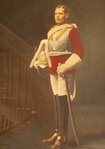
My very first post was about my Uncle Victor, the eldest of the Smedmore boys, who went to England in 1915 and joined the Life Guards of the Household Cavalry, was sent to France with the combined battalion of the Reds and the Blues which made up the Household Battalion of the British Expeditionary Force, and was killed in action in 1918. I never knew him of course, only what my mother would tell me about him, and what little information I found about him in the online Daily Gleaner, which reported on his joining up and on memorial services held after his death. The only picture I have of him is a large framed painting , which may have been a photograph which was colorized, showing him in his Lifeguard uniform.


I remember another picture of him, at 49 Beeston Street, one of a group of three soldiers in their khaki uniforms, but I have no idea where that picture ended up.
Victor was born in February 1886, and the next son, Norman, was born the end of November 1887. He is another uncle that I never knew, and in a way he's the real mystery man of the family. He doesn't seem to have been as popular with his sisters as was his older brother ... but then, getting killed in the war does give one a certain cachet. Norman, known by the family as Normy, also left Jamaica, but not to fight. Like many other Jamaicans he headed off to New York in June 1918, on board the ss Zacapa. On the ship's manifest he gave his next of kin as his mother at 49 Beeston Street, and stated he was going to stay in New York with a friend, Joseph Levy. Joseph Levy was the youngest brother of my father and had himself left Jamaica for New York in August 1917. Norman claimed on the manifest that he was going to the U.S. for six months but he certainly never returned to Jamaica. He lived there until his death in July 1953. I have no photographs of him and all I know of him is what I've been told by my mother, and what I've been able to find out through research. He settled first in Brooklyn where he worked as a traffic checker for the Public Service Railroad Company, and in September 1918 he filled out a registration card for the draft. After that he appears to have worked for the rest of his life in New York for Swift & Company, meat packers. Thanks to David Priever, a researcher in New York, I was able to get a copy of the administration of his estate from the Surrogate Court of New York ... like many of the Smedmores, he left no will ... and what ever else I know about him comes from this brief obituary in the Gleaner of August 8, 1953. That Norman was a Freemason doesn't surprise me as my grandfather and my Uncles Rodney and Owen also belonged to the Scottish Rite. I had not known that, like Victor, he attended Wolmer's Boy School, nor that he had worked for the lumber companies in question. I do know, from what my mother told me, that he would send money home for his mother and sisters, and I know, from a brief notice in The Gleaner that Elma went to New York on vacation in June 1951,so I imagine she must have visited Norman. One thing I do remember is how surprised the family was at how small his estate was -- according to the lawyer, Albert Stark, a mere $4,400. Considering that Norman never married, lived in lodgings and had worked steadily since arriving in New York, this small amount to be divided between his siblings, after all expenses had been paid, came as quite a shock.

I come now to the Smedmore uncles that I did know. The next one in the family was my Uncle Owen, born in November 1891 in Port Royal. To my mind he was the best looking one of the family and it always puzzled me that he never married.


I think one reason may have been that he had a speech impediment, a stammer, as did Rodney and Lucius, though I remember that Owen's seemed to be the worst of the bunch. There are probably all sorts of scientific reasons for speech impediments, but I feel pretty sure, from what my mother told me, that this was exacerbated by my grandfather's treatment of his sons. He had no patience when they stuttered and would tell them to speak up without stammering. I think Owen was probably shy. He worked all his life at D. Henderson and Company at the corner of King and Harbour Streets.

I remember him as gentle and generous. I could always touch him up for money at Christmas time when all the family gathered at 5 Holborn Road -- two shillings and sixpence or even five shillings, and then, of course, I would go to the other uncles and tell them how much I got from Owen, and they, not wanting to be outdone, would shell out as well.

I guess Owen felt he had an obligation to take care of his mother and sisters, once Victor had left for the war and Norman had emigrated to the States, consequently he lived at home with them, first at Beeston Street, and then later he moved with my aunts to 11 Dunrobin Avenue when the Beeston Street house was sold. I would say he had a very powerful sense of duty to his unmarried sisters and I know that he was a loving brother and brother-in-law. Sadly, he was on holiday when he died. The family had gone to White River for a vacation when Owen suffered a heart attack or a stroke while swimming.

In my next post I'll write about my other uncles, Rodney, Lucius and Julian. It may be a while as I'll be off line while on vacation for two weeks.

Thursday, 2 August 2007

Going Home ... 5 Holborn Road

Ah ... going home. It means so many different things to each of us. Think of the quotations you've heard about "home". Well, I have already quoted Thomas Wolfe ... "You can't go home again." But there's also "There's no place like home" (John Howard Payne); "Any place I hang my hat is home" (Arlen and Mercer); "Home is where, when you go there, they have to take you in" (Robert Frost). As for my feelings about home ... well, 5 Holborn Road was the place I spent the first twenty-two years of my life, from the time I was six months old, so I knew no other place as home.
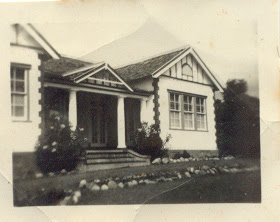
In 2003 when I went to Jamaica after an absence of more than twenty years, I had the opportunity to visit 5 Holborn Road which I had not seen for many years. My parents had sold the house in the sixties and moved, first to 11 Dunrobin Avenue and later to 4 Carvalho Drive. One of the last times I saw 5 Holborn Road was probably in 1960 and it looked like this.

There were two gates opening on an unpaved circular driveway, around which were beds of gerberas (African daisies) which my mother loved, and two huge bushes of pink oleander framed the front verandah.
I was staying with my cousin, Rosemary, near Montego Bay in 2003, and we decided to come to Kingston ... I should say New Kingston ... for the weekend to visit family and friends. We wanted to stay at a moderately priced hotel and, knowing that 5 Holborn Road was now the Indies Hotel, I suggested we stay there. So we did the long drive from Montego Bay to Kingston and finally arrived at 5 Holborn Road. I must admit to feelings both of anticipation and some trepidation at seeing my home again. I had seen a photograph of it some time before, but the actual view was indeed a surprise.


My first reaction was: "Good Lord! They've paved over the lawn and the gerberas". But, of course they had to, in order to provide parking for their guests, and different as the outside of the house looked, I was pleasantly surprised on entering it to discover that, apart from renovations to the interior, I could recognize the house itself. It could so easily have been demolished in order to build a hotel there, but instead the owners had built an extension on the existing house and kept the character of the original building. The extension was built around the property to connect with the original outbuildings and garage and excellent use has been made of them. The rooms are on two levels behind the house with a courtyard in the middle, and if indeed the flowers in front were gone, it was more than made up for with the masses of tropical plants in the courtyard.
Here is a view of the upper level of the guest rooms, built around the original house. I stayed in number 12.


The added building extends to the old outbuildings and the detached garage is now part of the entire structure.

Along with the palms and ferns one finds a riot of colour with ginger liles and other tropical flowers. The former garage is the dining room and bar,where I enjoyed a typical Jamaican breakfast of salt fish and ackee.


The interior of the house has changed and yet I could still see traces of my old home. Here is a picture I took in 1960 of our dining room.


At the left rear one can see the door to the pantry, and at the rear the entrance to the latticed in back verandah. (I remember a picture that used to hang on the wall to the right of the window looking out on the back verandah. It was a black and white print of Millais's "Princes in the Tower".). The dining room is now the lobby of the hotel and looks like this.

As you can see, the entrance to the pantry has been blocked off; the back verandah now forms part of the lobby and office and is no longer latticed in, and the windows have been changed. The floors are still the gleaming mahogany that they were when I was growing up here and it was kept that way with a coconut brush and great amounts of elbow grease.


What were my thoughts on seeing my old home again? I was pleased that it had not been changed out of all recognition, and that in fact the renovations made were appropriate to the character of the house itself. It was, of course, no longer home, but it was welcoming and familiar, and strangely enough, seemed quite a bit smaller to me than it had been when I was growing up there.

One last thing ... occasionally I dream of home and family now gone, and when I do it is 5 Holborn Road that I see in my dreams.

Thursday, 12 July 2007

Holborn Road Families

What I mostly remember about Holborn Road were the families who lived there while I was growing up. Next door to us, at number 3 Holborn Road were the Bewleys, Arthur and Enid. They had three children: Dawn, who married a sergeant in the British Army who was stationed at Up Park Camp; Sheila, who was about my age, and Richard. Sheila and I were best buds, though we attended different schools. She went to St. Hugh's and I went to St. Andrew's. We played together a lot. The Bewley had a badminton court on the front lawn, with lights, so we played a lot of badminton. We also used to go to the movies together ... the Saturday morning serials at the Carib Theatre. We also used to go swimming at Courtleigh Manor Hotel, where for the princely sum of two shilling and sixpence we were allowed to frolic in the hotel pool.

Tourism wasn't that big in Jamaica in those days and the hotel was very welcoming to local people. We had great times swimming there. And this reminds me that in my last post I mentioned the Skyline Hotel and wondered what had happened to it. Well, thanks to a couple of people in the know, the Skyline was bought out by the Hendrickson family and renamed the Courtleigh, and Courtleigh Manor itself, also owned by the Hendricksons was, sadly, demolished a couple years ago.

When I went back to Jamaica in 2003 Holborn Road had changed drastically from a residential street to a very commercial one, and No. 3 Holborn Road, where the Bewleys had lived, is now a guest house, Holborn Manor.

In fact the street looks quite different. Here is a view of it looking towards Trafalgar Road, with no. 5 and no. 3 Holborn Road on the left.

I do not recognize the large buildings on the left, past the Bewley's house. In my time no. 1 Holborn Road was where the Atkinsons lived, and next to them going towards Trafalgar Road, was the home of Eric and June Clark, whose house address was actually on Ruthven Road behind Holborn Road. Their property was contained between both roads, with gates at either end, and with their permission I used to ride my bike through there as a shortcut to go to school

On the even-numbered side of the road were the Tames. I don't recall their house number. They were very close friends of my Mom and Dad. Captain Frederick Tame had been in the British Army and had settled in Jamaica with his wife, May. They had four grownup children, two girls and two boys. Lily and Violet were unmarried and lived with their parents; Cyril was married and worked at Barclays Bank in Kingston, and Horace the youngest, also married, worked at the Cement Company.

That's Vi on the left with Captain Tame. She's holding one of their Pekingese dogs. I remember they had two, at different times.

This is Lily, the eldest. Lily was secretary to Mr. Bertram, the rather august manager of Barclays Bank. Thanks to Cyril both my brother, Micky, and I worked at Barclays. Micky was probably there longer and moved around to various branches. I worked there after leaving school between 1953 and 1957, when I got married and went to Trinidad.

Other families who lived across the road from us were the Parchments, Lal and Cissie, next door to the Tames, and next to them the Evanses, Fred and Sybil with their three children, Bev, Phyllis and Richard. On the corner of Dumfries Road and Holborn Road at no. 10 were first the Williamses, Baba and Verna and their children, (Verna was the sister of my Aunt Maisie who married my Uncle Lucius.), and later on after the Williams family moved, the McCullochs. On our side of the road, next door at us at no. 7 there were the DeMercados, Roy and Rose, sister and brother, and later the Dadds. My mother was very fond of Roy who was quite a character. The funny thing is that in a way our families were connected through marriages between Da Costas and DeMercados, but I don't think any of us were really aware of that. It's something I found out much later when I began to do family history research.

The Evans home is now the Indies Pub, and that section of Holborn Road, looking towards Chelsea Avenue, is much different to what I remember as a child.

In fact, no. 7, next door to no. 5, is now a financial institution, Dehring, Bunting & Golding Ltd.

In my next post I'll describe how it felt to return after twenty years to my old home and experience the changes that time has wrought.

Wednesday, 11 July 2007

Going Back ... Holborn Road Then and Now

In April 2003 I returned to Jamaica for a visit after an absence of twenty years. My cousin, Rosemary, had invited me to stay with her and her husband, Norrie, for a few weeks at their home outside of Montego Bay in Coral Gardens. It was quite a trip, going back after all that time. Things were the same, and things were different. My plane landed at Sir Donald Sangster Airport in a hot and humid afternoon. When I arrived at Immigration the officer welcomed me back to Jamaica. It was almost like coming home!

I'll write more about that trip to Jamaica but what I really want to talk about is our weekend in Kingston, or I should say, New Kingston. We discussed where to stay while there and I suggested that we stay at my old home, 5 Holborn Road, which is now the Indies Hotel. But, before I describe my experiences there, let me tell you something about Holborn Road, then and now.


The above map is a recent one and the terrain I'm going to describe was probably a bit different from the present. As you can see, Holborn Road runs off of Trafalgar Road (which in turn runs off of Hope Road). Presently Holborn Road runs into Chelsea Avenue, which in turn ends at Half-way Tree Road, but when I was a child living on Holborn Road it didn't run right through ... that came later. I remember that Renfrew Road ran off of Holborn Road, just south of Trafalgar Road, and then lower down there was Dumfries Road which dead-ended at a gully, past which was Knutsford Park Race Course.

When the races were on we could hear the noise from the race track at our house on Holborn Road. I remember going to the races with my cousin and her family and even placing a bet.

The race course is gone now ... Knutsford Park became New Kingston with hotels, stores and businesses, and horse-racing is now carried on at Caymanas Park. The postcard below shows the Skyline Hotel, New Kingston, probably from the sixties or early seventies, one of the first hotels built there.

This is where the late Perry Henzell filmed The Harder They Come (1972). The postcard from which this picture comes is unused, but someone has written on the back:

"This is one of our best hotel [sic] the Skyline and in the background is another hotel it is called the Sherton [sic] hotel I can stay at my school and see the top of Skyline"

What happened to the Skyline? Did it morph into one of the other hotels, the Pegasus for example? If anyone knows, please leave a comment. In my next post I'll write about some of the other families who lived on Holborn Road.

Monday, 2 July 2007

You Can't Go Home Again

Yesterday, July 1st, was Canada Day, the 140th anniversary of Confederation. I spent the day at the Highland Games at Embro, near Stratford, and sang our national anthem, "O Canada" with everyone there. The first line of that anthem always gives me pause:

"O Canada, our home and native land" .... well, like the thousands of Jamaicans who have made their home in this wonderful country, Canada is indeed our home. I have spent two-thirds of my life here ... I'm a proud Canadian citizen, and my children and grandchildren are Canadians, but home? That's a tough one. After forty-seven years, yes it's home, but I still feel a connection to my "native" land. (It's too bad that they can't come up with a better word than native in the national anthem for those of us who chose to make Canada home.)

I'm looking at a certified copy of my birth registration, number BM 8896, in the District of Cross Roads, Saint Andrew. It's too long to scan on my little 8 1/2 x 11 scanner. I was born at Nuttall Memorial Hospital, 31 May 1935. My father was Michael Leopold Levy, civil service clerk of 7 Anderson Road, Woodford Park, Saint Andrew, and my mother was Maud Dey Levy, formerly Smedmore. My father registered my birth on July 3, 1935. Well, I don't remember Anderson Road in Woodford Park, because when I was about six months old, my parents bought a house at 5 Holborn Road, St. Andrew from a Mr. Garsia, and moved there, and that house was the only home that I knew for my life in Jamaica, until I left there in 1957.
This is the house I remember ... 5 Holborn Road. It was situated off of Trafalgar Road. At one point Holborn Road ended in a dead end, which later was developed as Chelsea Avenue, which in turn ran out to Half-way Tree Road. Holborn Road ran south of Trafalgar Road, and there were two side roads off of it ... Renfrew Road and Dumphries Road, before it ran into Chelsea Avenue. In my childhood Dumphries Road was a dead end which ended at Knutsford Park, the major horse-racing venue at the time. Now it's all gone and the area I lived in is known as New Kingston, but more of that later.

Here I am as a child with my brother, Micky, with our nurse, in front of the house at 5 Holborn Road.


The house, as I remember it, was quite large. There was a large front verandah with four large pillars supporting a gable roof. Off of the front verandah were four French doors. The two in front opened into the dining room. One on the left opened into the drawing room, and the one on the right opened into my parents' bedroom. On the left side of the house, behind the drawing room, was a bedroom with a full bathroom. This was my brother's but I also remember that during the war it was occupied by a boarder, a mysterious Mr. Wellard. Moving back, on this side of the house were the pantry and kitchen. On the right side of the house, was my parents' bedroom. Off of it was a dressing room with a sink, the bathroom which contained the bath only, and there was a separate room for the toilet. Behind this was my bedroom, and behind that, a spare bedroom which was occupied for some time by my Aunt Tess when she lived with us. In the middle of all this was the dining room, off which the other rooms were situated, and at the back an enclosed latticed verandah. To me the house was quite large. It sat on a quarter acre of land. In the front there were two gates and a grassy driveway connecting them, and a lawn enclosed by a privet hedge. (It was not really privet, as I discovered later, but a type of barberry.) My mother's pride and joy were the garden beds in which she grew flowers. The ones I mainly remember were gerberas, also called African Daisies.

We had a detached garage, though for a long time we had no car. This sat at the end of the driveway leading from the south gate entrance.
By the time this photo was taken we did have a car. These photos aren't that great. They were taken with a Brownie 120 camera, but hopefully you get the idea. Though it's a bit hard to make out, on the right side of the photo you can see that there was a separate entrance to the bedroom on the left side of the house (Micky's bedroom aka the spare bedroom).

In the backyard we had all sorts of trees: a huge breadfruit tree which my brother climbed and claimed he could see Kingston Harbour from it -- a grapefruit tree, a Valencia orange tree, mango trees (Bombay, Julie, Number Eleven, Hairy), an ackee tree ... and we also had a chicken coop and kept a few chickens who came to a sticky end so we could have chicken dinner.

These are my memories and I think this photo of me with my parents is one of my favourites.

On either side of the verandah were planted pink oleander. I remember also that we had pointsettias and euphorbia which were a riot of colour, red and white, come Christmas.

These are my memories of the house at 5 Holborn Road. My parents sold the house after I left home. By then my brother was married and the place was too big for them. They sold the house to a Canadian from Guelph who turned it into a hotel ... more of this later ... and moved to 11 Dunrobin Avenue. Later they moved with my Uncle Rodney to 4 Carvalho Drive.

The house at 5 Holborn Road still lives in my memory as my home till I was 22 years old and left Jamaica. It has changed dramatically, and those changes will be the subject of my next post. But still ... the memories are there and they are what I see when I think of "home".

Arras Memorial

Arras Memorial

Trooper Victor Dey Smedmore

Trooper Victor Dey Smedmore
My uncle Victor