Saturday, 16 May 2009

Joseph and Hannah Da Costa

Once again I have been tardy in updating my blog. I feel that I have left Joseph and Hannah Rodrigues Da Costa in limbo while I dealt with other responsibilities. It's way past time to get back to their story -- a story I've managed to piece together using what records I could find about them and their family as well as stories in the Jamaica Gleaner. It's hard to put together a family history when you have no context, only names to go by, so I've been really lucky to find various bits of information in the Gleaner which have helped me enormously.
Joseph was the proprietor of the Commercial Rooms at 101 Harbour Street, as per an advertisement in the 1891 Kingston Directory, which appears on the Jamaican Family Search website as follows:
Commercial Rooms
101 Harbour Street (Upstsirs)
Bar & Billiard Saloon
Joseph DaCosta, Proprietor
N. B. Telegrams received daily, and can be read immediately on arrival. Also late English and American papers.
Telephone 167
Besides this ad he also advertised regularly in the Jamaica Gleaner. One of the earliest ads I found was this one in the February 15th, 1894 Gleaner:

Joseph seems to have imported all sorts of goodies for sale at the Commercial Rooms so he was quite the entrepreneur. Most of the ads I found were of this nature.

How did Joseph come to own the Commercial Rooms in the first place? Well, based on a brief article I found in the Gleaner of January 6, 1886, it appears that Hannah, his wife, was the original owner and Joseph was her manager. (At this time they were not married though they had had three children together.) The report in the Gleaner stated that Hannah, as proprietress of the Commercial Hotel, had appeared in District Court charged with keeping her hotel open later than eleven o'clock and also "unlawfully and knowingly permitting disorderly conduct in the same hotel on the night of the 9th December last." The defence was that on the night in question a large group of disorderly sailors, armed with marlin spikes, had entered the hotel "for the purpose of avenging an insult that one of their comrades had received the night before. Seeing that they meant mischief, Mr. Joseph DaCosta, the manager of the hotel, did his best to induce them to leave quietly." Fortunately the defence was accepted and his Honour decided in favour of the defendant.

Joseph's bravery did not go unrewarded as he and Hannah were married two years later on November 22, 1888, and from then on it is Joseph's name that is associated with the hotel and billiard rooms. Many ads appeared in the Gleaner extolling the various imported foods that Joseph had brought in. Joseph was also involved in horse racing. An ad in the Gleaner in 1891 for the Cumberland Penn Races stated that tickets for the grounds, stands and carriage enclosure could be purchased at the Commercial Hotel, at four shillings and ten shillings and sixpence respectively for the Grand Stand and Special Stand. An interesting sidelight to Joseph's career, particularly as his son, Eugene became quite the turfite and even wrote a book on the history of horse-racing in Jamaica.

Joseph died at the relatively young age of sixty-three in 1910 of chronic heart disease, certified by Dr. F. H. Saunders. His obituary in the Gleaner of September 27th, 1910, referred to him as "well known for his sterling character and his great business ability. All those who came in contact with him -- and his friends were legion -- admired his pleasant disposition, his quiet demeanour, and his charitable qualities."

Hannah outlived her husband for many years, dying at her home in Rae Town on 27 April 1925. Her obituary in the Gleaner spoke of her as charming in her manner and a pleasure to converse with.

Sunday, 22 March 2009

Discovering Da Costas: And Joseph Makes Three

Today is Mothering Sunday in the Anglican Church, a day when mothers are celebrated. Mothering Sunday has a long tradition in English customs as it was the day when those in service were given the day off to visit their family, and it was also the day when one returned to the mother church, such as the Cathedral in one's Diocese. Mothering Sunday falls in the middle of Lent and is a break from the abstinence of the season; the tradition is to serve Simnel Cake and give the ladies a flower to celebrate the day. I bring this up because I'm feeling rather guilty for neglecting the family blog I've been mothering these past several months ... so, once again, I'm returning belatedly to the Da Costa story.


In my last post I wrote about Melbourne and his family and how I found out about his parents, Jacob and Selina Rodrigues Da Costa, who were also, of course, the parents of my grandmother Alice. I knew that Melbourne and Alice had a brother, Joseph, but I had not so far done any research on him. I did have a photo of a tombstone in Calvary Roman Catholic Cemetery which was very likely that of my great uncle, Joseph Rodrigues Da Costa.


So I started doing some research on Joseph. I went looking first of all for a marriage record for a Joseph Rodrigues Da Costa, figuring that he would most likely have been married around the same time as Melbourne. I did find such a record, on 22 November 1888, which stated that Joseph Rodrigues Da Costa, a tavern keeper, age 41, son of Jacob Rodrigues Da Costa, had married Hannah Lindo, a spinster, age 38, daughter of Jacob Lindo, at 101 Harbour Street (which both had given on the record as their abode), by a William J. Brown, the witness being one Ada Clement Da Costa. It seemed very likely that Joseph was the brother of Melbourne and Alice, as his father was also Jacob Rodrigues Da Costa, so the next question was, did this couple have children?

With the assistance of Father Gerry McLaughlin at the Roman Catholic Archives in Kingston, I was able find out more about Joseph and Hannah. They did have children, three in fact, all of whom were born quite some time before the marriage of their parents! The children were Ida Clementina, born 1871, Eugene, born 1873 and David, born 1876. Father Gerry also found a record of Joseph's marriage in the register, in Latin, entered by the Rev. Fr. William Spillman, S.J., as follows:

"A. D. 1888, die 22 Novembris conjuncti sunt in Matrimonium Joseph R. Da Costa & Hannah Lindo a P. Guls. Burns, S. J. praesentibus testibus D. M. Leon, Ida Clement Da Costa. Ex reg. civili G. Spillmann, S. J."

The witness, Ada Clement Da Costa was in fact their eldest daughter, Ida Clementina, who would have been seventeen years old. Why did it take so long for Joseph and Hannah to get married? What was the impediment? That's probably something that we'll never know. Was Hannah Jewish, and was there some resistance on the part of her family to her marrying a Catholic? What evidence I've been able to find shows that Hannah was a devout Catholic, but it's possible that she might have been a convert to Catholicism.

My next step was to find Joseph's death record and see if he had left a will. Success on both counts! Joseph died at 57 East Queen Street on 26 September 1910 of chronic heart disease, as certified by Dr. F. H. Saunders. The informant on the death record was his youngest son, David, who had been living in England but had come to Jamaica during his father's illness. And Joseph did make a will, which was probated in the Supreme Court of Jamaica.


His will gives the definitive proof that he was indeed brother to Melbourne and Alice as in it he left "to my brother Melbourne DaCosta one hundred pounds and to my sister Alice Levy one hundred pounds." He appointed his wife, Hannah as joint executor with his younger son, David; he left £300 to each of his children, and the rest and residue of his estate to his wife, Hannah.

Knowing as little as I did about this part of the family, I wanted to find out more about Joseph and Hannah, and I was fortunate enough to learn more by researching in the pages of the Jamaica Gleaner on line. In my next post I'll describe what I found there.

And now for a little shameless self-promotion. I've just today received an email from Blog Jamaica who are featuring my blog this week! Naturally, I'm pleased!

Sunday, 8 February 2009

Discovering Da Costas: Putting the Pieces Together

It's been quite a while since my last post ... other stuff gets in the way ... At any rate I wanted to return to my research on the Da Costa family and talk about how I went in search of them and what I found. It wasn't at all straightforward. Sometimes genealogical research can be very fruitful -- other times not!


In my last post I wrote briefly about my great uncle, Melbourne Rodrigues Da Costa. As I said, I knew of his existence because my uncle Rodney had told me that my grandmother, Alice, had two brothers, Joseph and Melbourne. In my research I found a marriage record for a Melbourne Rodrigues Da Costa to an Abigail Henriques DeSouza. Here is a copy of that record:


The record states that Melbourne Da Costa, age 23, bachelor, small trader, son of Jacob Rodrigues Da Costa, married Abigail de Souza, spinster, dressmaker, age 22, daughter of Joseph Desouza, on the 24th of May, 1882, and that the marriage was performed in Kingston by Alexander Robb.The names of the two witnesses are almost illegible; one appears to be Wm. M. Holland. Further research on my part showed that Alexander Robb was a Presbyterian minister. Whether or not they were married in a church was not stated and I'm inclined to think that the marriage probably took place in a home, perhaps the bride's home. Certainly the bride wore a wedding dress. My cousin, Kay, Melbourne's great granddaughter, sent me this photo of Abigail.

Unfortunately, we don't have a photo of Melbourne.

I discovered that the DeSouza family was Jewish, and later on I was able to confirm the fact that Melbourne had been baptized in the Catholic church. Now, I have come across marriages between Catholics and non-Catholics that were performed in the Catholic church, so long as the non-Catholic partner promised to bring up the children as Catholic. But Abigail had no such intentions, and indeed all their children were brought up Jewish and named in the synagogue records.

In looking back at the notes I made at the time I see that I wasn't sure that Melbourne, the son of Jacob Rodrigues Da Costa, was my grandmother's brother, because I didn't know her father's name! Alice did not get married in Jamaica, but in Colon. I discovered that later when I was sent a copy of the Gleaner notice of the marriage. I naturally first concentrated on my grandmother's family and found the births of all her children, whose names I did know. An interesting fact started to appear in some of the registrations. (There were seven births, and three deaths.) Two of the births (those of Daisy and my father, Michael), and two deaths (Daisy and Lucien) were registered by Selina Rodrigues Da Costa who, on Lucien's death record in 1887, described herself as "grandmother".

So, now I had another name. Selina Rodrigues Da Costa who had also signed Daisy's birth registration as Mrs. J. R. Da Costa, was obviously Alice's mother. Was the J. R. Da Costa she was married to by any chance Jacob Rodrigues Da Costa, Melbourne's father? I then found a death record in 1892 for a Selina Da Costa, who had died at 225 Tower Street. The person registering her death was her son, Melbourne Rodrigues Da Costa, also of 225 Tower Street. Voila!

Selina DaCosta is described as a widow in this record, so the next step was to find out more about her late husband, Jacob Rodrigues Da Costa.

And here I'd like to digress and go into my favourite genealogy gripe or whine ... all this would have been so much easier if I had had access to census records in Jamaica! The census is a wonderful genealogy resource -- it places the whole family together in one place at one time. In England and Canada it was taken every ten years on the ones, beginning in 1841. (In Ontario the nominal census, where everyone in the household is named, begins in 1851.) In the United States censuses go back even further and are taken in years ending in zero. The U.S has released censuses up to 1930; in the United Kingdom they are available up to 1901 and in Canada up to 1911. There are no nominal censuses of this nature for Jamaica! A few censuses exist, mainly early ones, but mostly what censuses exist are purely statistical in nature. Madeleine Mitchell, in the revised editon of her book, Jamaican Ancestry: how to find out more (Heritage Books, 2008), reports that censuses were taken, but that the schedules with household names do not appear to exist. Jamaican genealogists would kill to have those censuses!

In the mean time I was fortunate enough, thanks to a good friend, Dr. Anthony MacFarlane, a convert to Judaism, to get hold of copies of the records of the two synagogues in Jamaica, the Spanish and Portuguese synagogue (Sephardic) and the English and German Jews synagogue (Ashkenazi). In searching through I found a Jacob Rodrigues Da Costa, son of Joseph Rodrigues Da Costa and his wife, Esther Lazarus, who was born 12 October 1821, and who died 19 November 1871. This Jacob was buried in the Jewish cemetery. Was he the husband of Selina Da Costa? I searched for a marriage but without success. Nothing showed up in the Jewish records, the Church of England parish records, nor in the Dissenter marriage records. That left one possibility. Since both Melbourne and Alice were apparently Catholic then maybe Jacob and Selina were married in the Catholic church. However, the Catholic records have not been microfilmed by the LDS, so my only recourse at that time was to seek the help of the Archivist of the Archdiocese in Kingston, Father Gerry McLaughlin.

In my next post I'll continue with the saga of the Da Costa reseach.

Thursday, 1 January 2009

Discovering the Da Costa Family

When I began researching my family history I knew little or nothing about my father's mother's family, the Da Costas. I knew that my grandmother's maiden name had been Da Costa. What little I knew about her family came from my Uncle Rodney, whose facts weren't always accurate. As I mentioned in one of my earlier posts, he claimed my grandparents, Leopold Levy and Alice Da Costa, had been married in Haiti. Thanks to Madeleine Mitchell, who found a notice of their marriage in microfilm of the Gleaner, they were married in Colon, Panama. Here is the notice from the Gleaner of July 23, 1886:
The reference to Haiti was not entirely without some validity. When Essie, their fourth child, was born in 1891 Leopold was listed on the birth record as being in Port-au-Prince, Haiti, his occupation being given as "accountant".
At the time I was hearing about my grandmother's family from Uncle Rodney I did not know her father's name ... that came much later ... and Rodney didn't know it either. He did know that Alice had two brothers, Joe and Melbourne, but nothing else about them. As for my father, Michael, he never spoke of his family and when I was younger I didn't ask the questions I should have of him. There seemd to have been some sort of estrangement between my mother and her mother-in-law. I gather there was resentment on my mother's part that she had had to wait quite a long time to marry my father as he was helping to pay off the mortgage on the house at 22 Beeston Street. I got the impression that my father's family was not well off. My grandfather, Leopold, was a travelling man, supposedly an oculist, but in all the records I found which mentioned him that occupation was never given. I found such occupations listed as "book clerk", "accountant", "book-keeper". I know that he went to Colon, Port-au-Prince, and Havana, and no doubt to other places in Central America and the Caribbean. He seems to have rarely been at home, though often enough to father seven children. Leopold died in Cuba in 1917 and my father's two brothers and his sister emigrated at various times to the United States, leaving my father as sole support of his mother.
When I finally did get around to working on my Da Costa family I had very little to go on but the names Joseph, Melbourne and Alice. I was fortunate enough to find a cousin here in Ontario, also from Jamaica, who turned out to be the great granddaughter of my great uncle, Melbourne Rodrigues Da Costa. She had done quite a bit of research herself, questioning family members and recording all she had found. Curiously, I knew nothing about her family, and she knew nothing about mine. My cousin, Kay, is Jewish, and it appears that Melbourne embraced the Jewish faith as a result of marrying Abigail Henriques DeSouza who was Jewish. They were married in 1882 by a Presbyterian minister, Alexander Robb. As Melbourne was Catholic and Abigail was Jewish, neither could have been married in the faith of the other.
It is an interesting picture. Joseph, Melbourne and Alice were all baptized in the Catholic faith, and the children of the former and the latter were brought up in the Catholic church, but Melbourne's nine children were brought up in the Jewish faith. Religion brings people together and it can also keep them apart. I am sure that the reason I know so little about my Da Costa relatives has a lot to do with that.

Saturday, 20 December 2008

Musings and Memories of This and That

It's been quite a while since my last post, which was way back in early November. Wow! How time flies when you're busy doing other things. What things, you may ask? Well for one thing, I have taken on a volunteer position with my local genealogical society, the Halton Peel Branch of the Ontario Genealogical Society. I've had various positions on the HP Executive for quite a while -- as Awards Co-ordinator, Chairperson, Past Chairperson, Programme Co-ordinator -- and now I'm Cemetery Co-ordinator. One of the aims of the Ontario Genealogical Society is to locate and transcribe all known cemeteries in Ontario. Transcribing cemeteries is done by a team of volunteers who painstakingly record what is inscribed on the tombstones. With the advent of digital photography many branches are now compiling both a visual and written record of the cemeteries in their area. More that 6,000 cemeteries have been located in this province, and over 5,700 have been transcribed by the thirty branches of the OGS. Halton Peel Branch still has some cemeteries to be recorded, as well as recorded cemeteries to be published.

Why transcribe cemeteries anyway? Well, not only is it one way to preserve our heritage, but it is also extremely helpful to people engaged in genealogical research. Quite often a cemetery transcription may be the only record one finds of an early ancestor. Unfortunately, with a few exceptions, there appears to be no genealogical group in Jamaica doing this. There are all sorts of cemeteries in the island, many of which have fallen into disrepair and neglect, and few that have been entirely recorded. I am proud to say that much has been done to record our Jewish cemeteries on the island. I refer to the work of the late Jacob A. P. M. Andrade, whose book, A Record of the Jews in Jamaica from the English Conquest to the Present Time, contains transcriptions of the various Jewish cemeteries in the island. Unfortunately, the book, published in 1941, is out of print, but the cemetery records can be found on a subscription website, Jamaican Family Search. Another excellent book is that of Richard Barnett and Philip Wright -- The Jews of Jamaica: tombstone inscriptions, 1663-1880, which incorporates much of Andrade's work. And a new book has just been published, on the Hunt's Bay Cemetery, the oldest Jewish cemetery in Jamaica. This is The Knell of Parting Day, by Marilyn Delevante, who worked diligently to preserve this neglected cemetery.

It's a beautifully illustrated book and you can find out more about it at the Jews of Jamaica website.

Would that we had done more for the church and public cemeteries in Jamaica! Some work has been done by individuals on early monumental inscriptions, such as that by James Henry Lawrence-Archer in his book, Monumental Inscriptions of the British West Indies from the earliest date (1875) This has been transcribed by Patricia Jackson and is posted on her subscription website Jamaican Family Search. Another work is that of Philip Wright, Monumental Inscriptions of Jamaica (1966). Both of these books are currently out of print but have also been microfilmed by the Church of Jesus Christ of Latter-day Saints (LDS), aka Mormons and can be found in their library catalogue on the FamilySearch website. Most of the inscriptions recorded are mainly of Anglican churches. I know of no efforts made to record Catholic or public cemeteries.
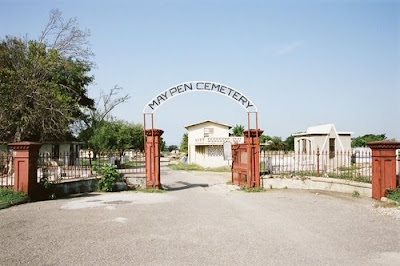
One of the largest nondenominational cemeteries is the May Pen Cemetery, in Kingston, pictured below.
This cemetery, one of the oldest public cemeteries, has become very rundown and neglected, but efforts have been made within the past two years at cleaning it up. As far as I know this cemetery has not been recorded.

Madeleine Mitchell, in her book, Jamaican Ancestry: how to find out more (2008) comments on how dilapidated the various cemeteries of the island have become. Stones are almost illegible, cemetery plots are overgrown, and it's not unusual for people to take up residence in the cemetery or to allow their animals to graze there! Such, I understand, has been the case with the cemetery of the Kingston Parish Church

where higglers have set up shop. Similarly, I am told one should not wander through the churchyard of St. Andrew Parish Church, Half-way Tree without an escort!


Donald Lindo has collected over 7000 burial records of St. Andrew Parish Church covering 1657 to 2000, and these can be found on his CD, Genealogy of Jamaica, 2006. Thanks also to Donald I have a photograph of the grave of my Great uncle, Joseph Rodrigues Da Costa, who is buried in Calvary Roman Catholic Cemetery.

I wish there was a genealogical society in Jamaica which would take on the job of recording our cemeteries before they are all completely lost!

Before I close, I would like to mention that my blog has received an award from another blogger, Jacqueline Smith, who also writes a Jamaican blog, Jack Mandora's, a book-lover's nook. The award is the Arte y Pico Award, and I display it here with pride! Thanks, Jacqueline!

Arras Memorial

Arras Memorial

Trooper Victor Dey Smedmore

Trooper Victor Dey Smedmore
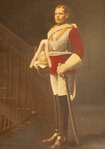
My uncle Victor